Friday, March 15, 2019

Don’t Let Your Luck Run Out! Buy A Home This Spring


Some Highlights:

  • Interest Rates for a 30-year fixed rate mortgage have dropped to 4.41% from near 5% in 2018.
  • Take advantage of more inventory coming to market in the spring to find your dream home!
  • Buying now will allow you to start earning equity today!

Thursday, March 14, 2019

Buying Your First House?


Owning your own home has been part of the American Dream for years. The pride of ownership and sense of belonging somewhere have been strong factors in motivating over 60% of all households to own their own homes. In addition, there can be true financial rewards from home ownership. But, not always.



How Much Home To Consider
Buying and owning a home is expensive. You will need funds for a down payment (perhaps 20% of the purchase price) and any mortgage closing costs before you buy. After you buy, you will have monthly mortgage payments, property taxes and insurance. Then, there are the other expenses like utilities and maintenance. Finally, if you are like most homeowners, you will want to furnish it. All of these items cost money.

Deciding how much to spend for a home can be complex. You probably want as nice of a home as possible, but you want to be able to afford it. What you can afford depends on the size of your mortgage, mortgage rates, costs of home ownership, your other expenses and your income. One rule of thumb to consider is that the total of your mortgage payment, property taxes and insurance should be no more than 28% of your household income. Here is a worksheet and a table of mortgage payments to help with the calculation.


Sample Monthly Mortgage Payments for a 30 Year Fixed Mortgage
Monthly Mortgage Payments at different interest rates (30-year fixed rate mortgage)
 
Mortgage Interest Rate
Mortgage Amounts
3.25%
3.50%
3.75%
4%
4.5%
5%
$50,000
$217.60
$224.52
$231.56
$238.70
$253.34
$268.41
$75,000
$326.40
$336.78
$347.33
$358.06
$380.01
$402.62
$100,000
$435.20
$449.04
$463.12
$477.41
$506.69
$536.82
$150,000
$652.81
$673.57
$694.67
$716.12
$760.03
$805.23
$200,000
$870.41
$898.09
$926.24
$954.83
$1,013.37
$1,073.64

Many financial websites include mortgage calculators to provide more precise payment levels and you can also calculate mortgage payments for other lengths of mortgages. You will need to adjust the worksheet below for your particular tax situation.
Worksheet

Sample
Sample


Mortgage amount
$100,000
$150,000
$
$
Monthly payment x 12
($477.41 x 12) = $5,729
($716.12 x 12) = $8,593


Property taxes
$3,500
$3,500


Insurance
$1,500
$1,500


Total
$10,729
$13,593


Household income
$50,000
$50,000


Times 28%
x.28
x.28
x.28
x.28
What you can afford
$14,000
$14,000


Difference
+$2980
Affordable
+$407
Stretching affordability
+ or –
+ or –

The sample is based on buying a $175,000 house with a 4% 30 year mortgage. As the chart shows, this person can probably comfortably afford buying the home with a much larger down payment. As a practical matter, the person could probably be comfortable with a mortgage in the $125,000 to $130,000 range. Of course, this is just a guideline for a rough estimate. Tax laws are always changing, and your situation may vary.

Tax benefits from home ownership
Many taxpayers find that the interest on their mortgage and the annual property taxes they pay are large enough to enable them to itemize their deductions instead of using what is commonly referred to as the standard deduction. For many homeowners, their interest and property taxes exceed those amounts. Be sure to keep track of when you pay your property taxes. Some taxing districts have due dates close to the end of the year, and you must have paid the tax before December 31 to get the deduction.

The IRS also allows you to exclude any gain on selling your house up to $500,000 if you file a joint income tax return and meet certain requirements. You may want to investigate these tax advantages further or talk to a tax accountant to completely understand the tax advantages. This is especially important now, because the new tax reform law has changed the tax landscape for homeowners in important ways.

Potential gains from selling your home
The housing market in many areas of the country is currently suffering. While that may be bad news for existing owners, it can be very good news for those buying their first home. When the housing market improves, and the odds are good that it ultimately will, the value of your home may rise.

Summary
If you are like millions of others, owning your own home is a primary financial and lifestyle goal. The pride of home ownership and the financial rewards are attractive. Just make sure you understand that there can be some downsides before you make the decision.

Want advice based on your unique situation and needs? Give me a call today.
 

HOME IS CALLING...


What do you see when you visualize your dream home? I ask you this, as it’s important that we see the same dream. I realize that the very best way to assist my real estate buyers to locate precisely the right home is to put myself into my buyer clients’ shoes.

I'm here to serve my buyers and create more than satisfied buyer clients.


Wednesday, March 13, 2019

Will Points Make a Difference?


Lenders typically quote mortgages at a market rate but can offer a lower interest rate loan if the borrower is willing to pay points up-front which is considered pre-paid interest.  These points are generally tax deductible for the year paid when the borrower pays them in connection with buying, building or improving their principal residence.
A point is one-percent of the mortgage amount.  A lender will quote a lower-rate mortgage with a certain number of points.  There is not a standard amount; it is an individual company policy.

A simple comparison of the two alternatives based on the borrower's ability to pay the points and whether the borrower will stay in the home long enough to recapture the costs will help to determine which loan will provide the cheapest cost of housing.

In the example below, two choices are compared; a 4.25% loan with no points vs. a 4.00% loan with one point.  If the buyer stays in the home at least 69 months, they will recover the $3,150 cost for the point on the lower interest rate.

If the purchaser stays ten years, he'll save two thousand three hundred dollars over the cost of the point.  A less obvious advantage will be realized because the unpaid balance on the lower interest rate loan will results in an additional $2,076 savings.

Use this Will Points Make a Difference app to discover whether paying points will make a difference in your situation.  This is an example of a permanent buy-down but temporary buy-downs are also available.  A trusted mortgage advisor can help you determine alternatives.

Tuesday, March 12, 2019

What’s Going On with Bidding Wars?


In a strong seller’s market, like the one we have experienced over the past few years, bidding wars are common and expected. This makes sense! A seller’s market is defined as a market in which the inventory of homes for sale cannot satisfy the number of buyers who want to purchase a home.

According to the Cambridge English Dictionary, bidding wars occur when two or more parties repeatedly outbid each other as they compete to purchase something- in this case, a home.

In some areas of the country, first-time buyers have been met with fierce competition throughout their experience. Some have been out-bid multiple times before finally winning a bid on a home to call their own.

According to the latest Existing Home Sales Report from the National Association of Realtors (NAR), there is currently a 3.7-month supply of homes for sale.


With the current number of houses listed for sale and the level of demand from buyers, this means it would take 3.7 months for all the homes listed to sell if no additional listings came to market. Any supply number under a 6-month supply is considered a seller’s market. According to NAR, the housing market hasn’t had a 6-month supply of homes for sale since August 2012.

Good News for Buyers

A recent report shows that the percentage of houses sold including a bidding war before settling on a final price decreased from 53% in January of 2018 to 13% this year.
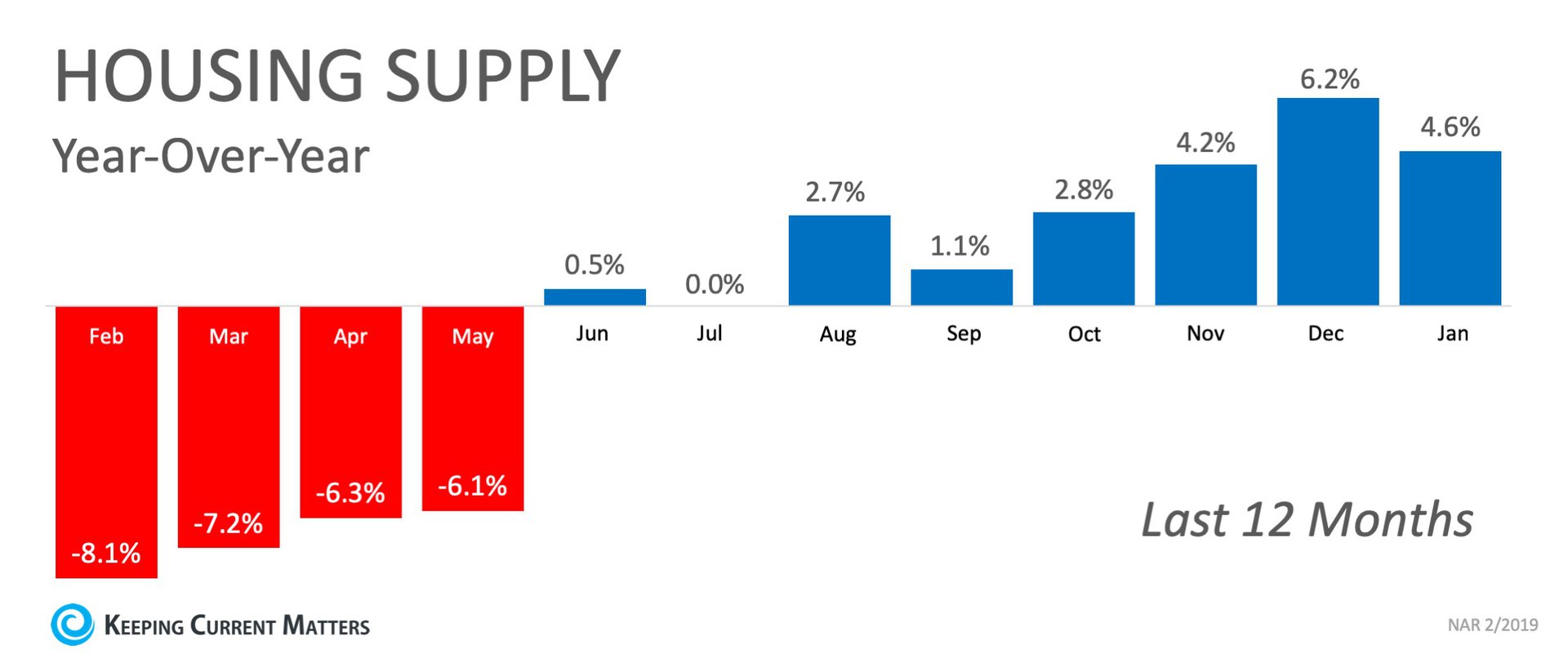
One reason for the decline is an influx of homes being listed for sale. Even though the month’s supply number is not increasing, the number of homes for sale is. The chart below shows the year-over-year change in inventory over the last 12 months.

What’s Going On with Bidding Wars? | Keeping Current Matters
­­
As you can see, the number of homes for sale has started to build over the last eight months. Prior to this reversal, inventory levels had fallen for 36 consecutive months when compared to the year before.


Danielle Hale, realtor.com’s Chief Economist, gave some insight into why bidding wars are less common on a local level this year,
“[Last year] you might have been the only listing in your neighborhood, and you could put your home up at a certain list price and you would likely see multiple offers at or above that list price. That tide is turning this year.
It’s going to depend on what neighborhood you’re in, but we expect it to be more common this year that you won’t be the only listing.”
Inventory in the luxury and premium markets (the top 25% of listings in an area by price), is increasing at a greater rate than the starter home market. As the choices buyers have continued to increase, the likelihood of a bidding war will decrease.

Bottom Line

If you are debating listing your house for sale this year, you may not want to wait for additional competition as inventory continues to rise.

Monday, March 11, 2019


4 Reasons to Buy a Home in the Spring


Spring has sprung, and it’s a great time to buy a home! Here are four reasons to consider buying today instead of waiting.

1. Prices Will Continue to Rise

CoreLogic’s latest U.S. Home Price Insights reports that home prices have appreciated by 4.4% over the last 12 months. The same report predicts that prices will continue to increase at a rate of 4.6% over the next year.

Home values will continue to appreciate for years. Waiting no longer makes sense.

2. Mortgage Interest Rates Are Projected to Increase

Freddie Mac’s Primary Mortgage Market Survey shows that interest rates for a 30-year fixed rate mortgage came in at 4.41% last week. Most experts predict that rates will rise over the next 12 months. The Mortgage Bankers Association, Fannie Mae, Freddie Mac, and the National Association of Realtors are in unison, projecting rates will increase by this time next year.

An increase in rates will impact YOUR monthly mortgage payment. A year from now, your housing expense will increase if a mortgage is necessary to buy your next home.

3. Either Way, You Are Paying a Mortgage

Some renters have not yet purchased a home because they are uncomfortable taking on the obligation of a mortgage. Everyone should realize that unless you are living with your parents rent-free, you are paying a mortgageeither yours or your landlord’s.
As an owner, your mortgage payment is a form of ‘forced savings’ that allows you to have equity in your home that you can tap into later in life. As a renter, you guarantee your landlord is the person with that equity.

Are you ready to put your housing cost to work for you?

4. It’s Time to Move On with Your Life

The cost of a home is determined by two major components: the price of the home and the current mortgage rate. It appears that both are on the rise.
But what if they weren’t? Would you wait?


Examine the actual reason you are buying and decide if it is worth waiting. Whether you want to have a great place for your children to grow up, greater safety for your family, or you just want to have control over renovations, now could be the time to buy.

Bottom Line

If the right thing for you and your family is to purchase a home this year, buying sooner rather than later could lead to substantial savings.