Tuesday, April 30, 2019

What Would Make You Sell Your House?


There are many reasons why a homeowner decides to sell their house and move. The latest Generational Trends Report from the National Association of Realtors asked recent home sellers to share their reason for moving.


The younger the respondents, the more likely their top response centered around needing a larger home (ages 29 to 53). Relocating for a job was the top reason for those ages 54 to 63 and the second most popular response for those under 53. The chart below shows the breakdown for these two reasons.
What Would Make You Sell Your House? | Keeping Current Matters
For homeowners over the age of 64, wanting to be closer to friends and family served as the top motivator to move. Downsizing to a smaller home or moving due to retirement came in as a close second and third.
What Would Make You Sell Your House? | Keeping Current Matters
Have you outgrown your current house? Are you a homeowner who can relate to wanting to be closer to family and friends? Is your house becoming a burden to clean now that the kids have moved out?

Bottom Line

Contact a local real estate professional who can help set you on the path to selling your current house and finding the home that fits your needs, today!

Monday, April 29, 2019

How Quickly Can You Save Your Down Payment?


Saving for a down payment is often the biggest hurdle for a first-time homebuyer. Depending on where you live, median income, median rents, and home prices all vary. So, we set out to find out how long it would take to save for a down payment in each state.


Using data from HUD, Census and Apartment List, we determined how long it would take, nationwide, for a first-time buyer to save enough money for a down payment on their dream home. There is a long-standing ‘rule’ that a household should not pay more than 28% of their income on their monthly housing expense.


By determining the percentage of income spent renting in each state, and the amount needed for a 10% down payment, we were able to establish how long (in years) it would take for an average resident to save enough money to buy a home of their own.


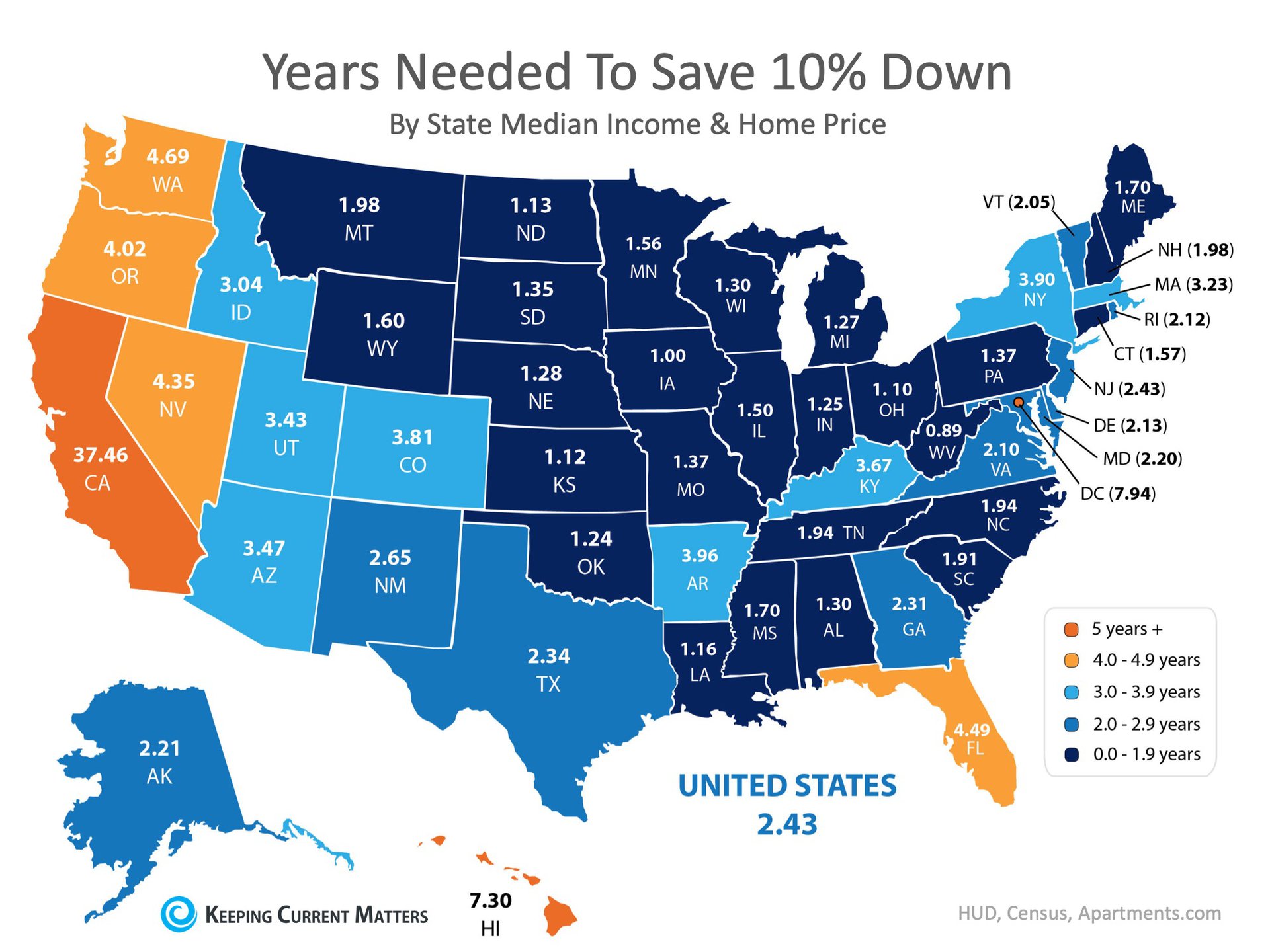
According to the data, residents in Kansas can save for a down payment the quickest, doing so in just over 1 year (1.12). Below is a map that was created using the data for each state:
How Quickly Can You Save Your Down Payment? | Keeping Current Matters

What if you only needed to save 3%?

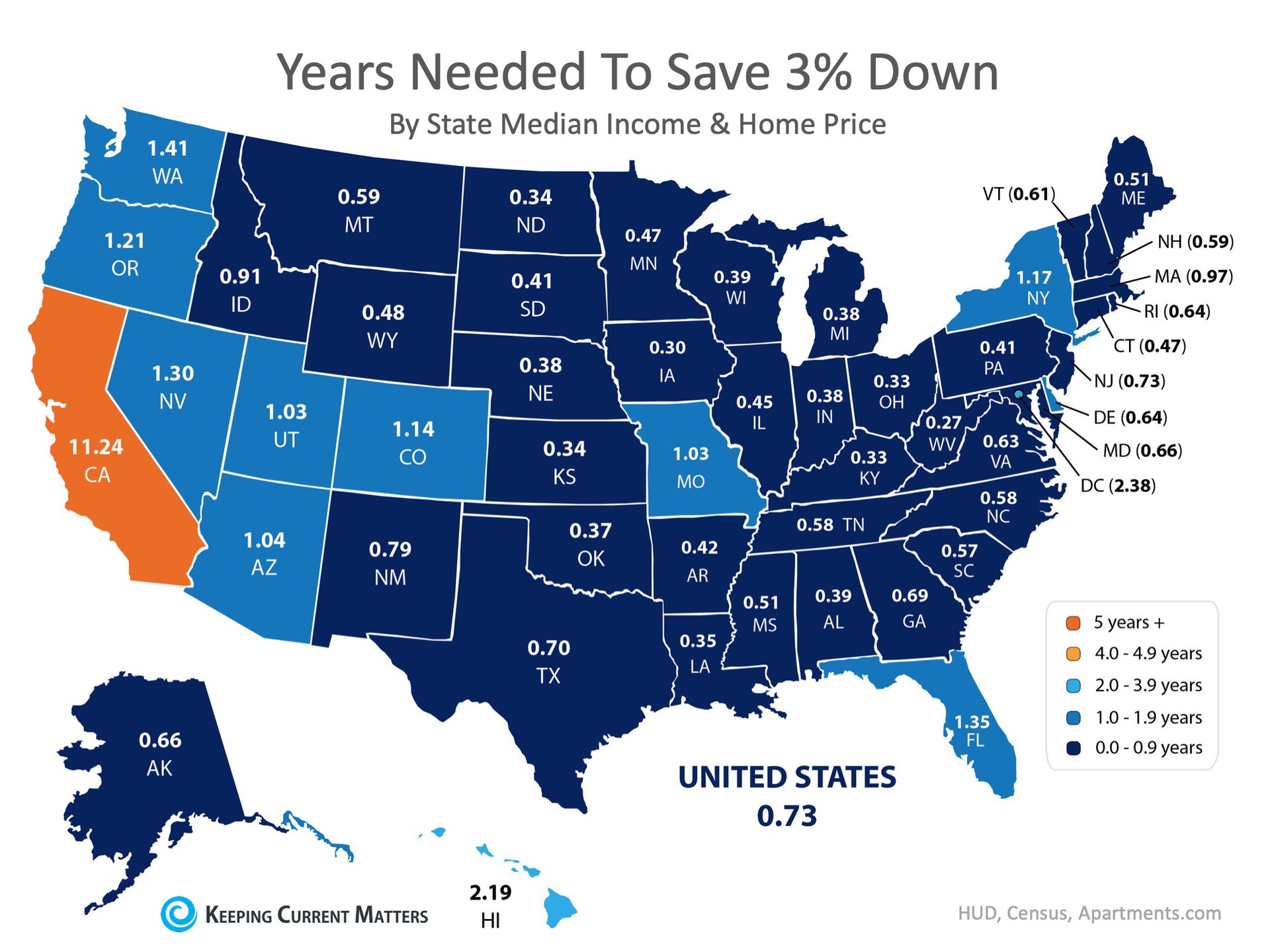
What if you were able to take advantage of one of Freddie Mac’s or Fannie Mae’s 3%-down programs? Suddenly, saving for a down payment no longer takes 2 to 5 years, but becomes possible in less than a year in most states, as shown on the map below.
How Quickly Can You Save Your Down Payment? | Keeping Current Matters

Bottom Line

Whether you have just begun to save for a down payment or have been saving for years, you may be closer to your dream home than you think! Meet with a local real estate professional who can help you evaluate your ability to buy today.

Friday, April 26, 2019

What Can Smart Switches and Light Plugs Do For Your Home?


“Siri, how much water did I drink today?”
“Alexa, what’s on TV tonight?”
“Google, turn off the lights!”

You know the drill. We’re all starting to talk to ourselves under the guise of speaking to our smart speakers and voice assistants. There’s nothing at all wrong with this, but it’s a future no one could have conceived even a decade ago. Smart speakers were cool for creating grocery lists, but that’s just a fraction of what they’re capable of now.

Your computer friends can control your lights and outlets from anywhere now. How cool is that?

The Power of Smart Switches and Plugs

Smart switches and plugs are among the most underrated components of a smart home. In fact, they’re a cheap way to get into the smart home world if your home wasn’t built with this type of equipment in mind.

They’re simple to install and essentially disappear after a few days. After all, they’re just boring plugs and switches, right?

Well… that’s one way to look at it. But, then again, how long do you go in a day without interacting with an outlet or a switch? Are you using either right now?

Behold the Handy, Hidden Household Helpers

If you really think about it, you use outlets and switches all the time for a wide range of reasons. Smart switches and smart plugs are no different, they’re a frequent touch item in your home. But they’re so much more than power regulators. Smart switches and plugs can do things for your household like:
  • Making mornings tolerable. Most people have heard of the coffee pot that’s powered using a smart outlet. You fill it up at night, then your programmed smart outlet switches on in the morning and starts the coffee cycle. It’s a popular trope, but it’s also a real thing… so you have that to look forward to.
  • Proving peace of mind. Whether you’re across town or across the state, it’s not a great idea to advertise that you’re not home at night. Your smart switches and plugs can be programmed to flip on and off at different times to make it appear that you’re just hanging around the house.
  • Conserving resources. Believe it or not, a lot of homeowners find that they save a lot of energy with smart plugs. The better units have use reporting built in, all you have to do is check your app to see which ones are using up the most juice. Create a schedule for those plugs, then check your usage again in a few months. Adjust the whole thing as necessary.
  • Creating a safer indoor environment. Are you the kind of person who doesn’t like to walk into a dark house, even when it’s yours? Then smart switches and outlets should definitely be on your shopping list. You can turn all the lights in the house on when you pull into your subdivision or driveway, making it clear that you’re home, in case any ghouls (or burglars) happen to be lurking.
  • Assisting people with handicaps. You may not need the help now, but even a debilitating sports injury can be enough to make you want to scream when you forget to turn a light on or off and are already across the room. For people who are permanently disabled, that’s an every day event. Today with the help of Siri, Alexa and Google Home Assistant, all anyone needs to do is shout, “Siri, turn off the kitchen lights!” and it’s a done deal.
Those little almost-invisible switches and outlets are pretty busy, looks like. They’re also an inexpensive way to jumpstart your smart home transformation. For example, if you wanted a way to turn your bedroom’s ceiling fan light off at night, you would save a bundle to install a smart switch versus using smart light bulbs and the switch won’t burn out any time soon, so bonus!

Ready to Make a Move Toward a Smarter Home?

Even if you have an older home, you can start transforming it into a smart home with switches and outlets. Every home and family will have different needs that a smart home can service, but due to the dizzying array of equipment out there, it can help to speak to a home pro about your plans.

Thursday, April 25, 2019

Renters Paying Substantially More While Owning Costs Less


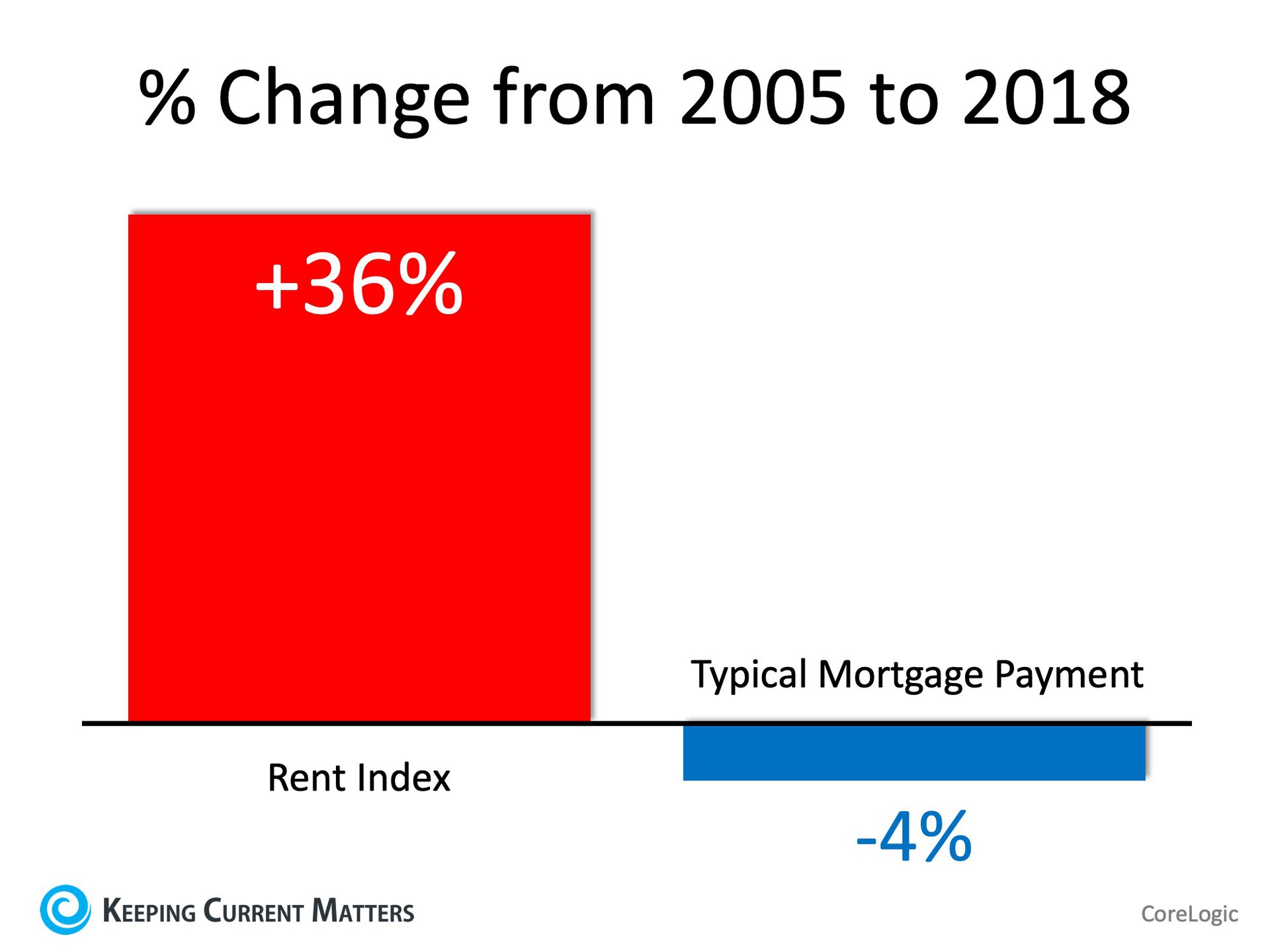
In a recent Insights Blog, CoreLogic reported that rent prices have skyrocketed since 2005. Meanwhile, the typical mortgage payment has actually decreased.
“CoreLogic’s national rent index was up 36% in December 2018 compared with December 2005, while the typical mortgage payment was down 4% over that period.”
Renters Paying Substantially More While Owning Costs Less | Keeping Current Matters

Why the difference between the costs of renting versus owning?

It makes sense that rents have risen. However, how did mortgage payments decrease? CoreLogic explained:
“It’s mainly because mortgage rates back in December 2005 were significantly higher, averaging 6.3% for a fixed-rate 30-year loan, compared with 4.6% in December 2018.
The national median sale price in December 2005 – $190,000 – was lower than the $220,305 median in December 2018, but because of higher mortgage rates in 2005 the typical monthly mortgage payment was slightly higher back then – $941 – compared with $904 in December 2018.”
Additionally, a recent report by the National Association of Realtors (NAR) showed that purchasing a home requires less of your monthly paycheck.
According to the Economists’ Outlook Blog, NAR’s February 2019 Housing Affordability Index showed that the “percentage of income needed” to pay the typical mortgage has decreased the last three months.
  • November – 17.3%
  • December – 16.9%
  • January – 16.2%
  • February – 15.9%

Bottom Line

What does this all mean to the current housing market? We think First American said it best in a post last week:
“The mortgage rate-driven affordability surge has arrived just in time… Rising affordability has already benefited home buyers and, if the lower rate environment persists, we’re in for a great spring home-buying season.”

Wednesday, April 24, 2019

New Study Reveals One Surprising Reason for the Inventory Shortage

There has been a great amount written on millennials and their impact on the housing market. However, the headlines often contradict each other. Some claim this generation is becoming the largest share of first-time home buyers, while others claim millennials don’t want to own a home, blaming them for the dip in homeownership rate.


While it is true that millennials have achieved milestones like getting married, having kids, and buying homes later in life than their parents and grandparents did, they are not solely to blame for today’s housing market trends.

Freddie Mac’s Insight Report explored the impact of the Silent and Baby Boomer Generations on the housing market.

If millennials are unable to find a home to buy at a young age like their predecessors, then who is living in those homes?

The answer: Seniors born after 1931 are staying in their homes longer than previous generations, instead choosing to “age in place.”
Freddie Mac found that,
“this trend accounts for about 1.6 million houses held back from the market through 2018, representing about one year’s typical supply of new construction, or more than half of the current shortfall of 2.5 million housing units estimated in December’s Insight.
Older Americans prefer to age in place because they are satisfied with their communities, their homes, and their quality of life.”
According to the National Association of Realtors, inventory of homes for sale is currently at a 3.5-month supply, which means that nationally we are in a seller’s market. A ‘normal’ housing market requires 6-7 months inventory, a level we have not achieved since August 2012.
“The most important fundamental in today’s housing market is the lack of houses for sale. This shortage has been identified as an important barrier to young adults buying their first homes.”

Bottom Line

If you are one of the many seniors who desires to retire in the same area you’ve always lived, you’re not alone. Will your current house fit your needs throughout retirement? If you have any questions about demand for your house, meet with a local real estate professional who can show you the opportunities available today!

Tuesday, April 23, 2019


From Alpharetta, Buckheadand Midtown to Downtown, East Atlanta and beyond, when it comes to buying a home, now more than ever, it's not just about a pretty porch, a beautiful a view or convenient commute to work. It's about all of the above and more. And the best part is these days you can have it all. In Midtown alone, there are so many charming neighborhoods, and some you may not even know about. From Virginia Highlands and Atlantic Station to Morningside.

Check it out, give me a call, or send me a text or email. Are you ready to have the lifestyle you've been dreaming of? 

timgrissett.com

Monday, April 22, 2019

Selling Your House: Here’s Why You Need A Pro In Your Corner!


With home prices on the rise and buyer demand still strong, some sellers may be tempted to try to sell their homes on their own rather than using the services of a real estate professional.

Real estate agents are trained and experienced in negotiation while, in most cases, the seller is not. Sellers must realize that their ability to negotiate will determine whether or not they get the best deal for themselves and their families.

Here is a list of just some of the people with whom the seller must be prepared to negotiate with if they decide to For Sale by Owner (FSBO):

  • The buyer, who wants the best deal possible
  • The buyer’s agent, who solely represents the best interests of the buyer
  • The buyer’s attorney (in some parts of the country)
  • The home inspection companies, which work for the buyer and will almost always find some problems with the house
  • The termite company, if there are challenges
  • The buyer’s lender, if the structure of the mortgage requires the sellers’ participation
  • The appraiser, if there is a question of value
  • The title company, if there are challenges with certificates of occupancy (CO) or other permits
  • The town or municipality, if you need to get the CO permits mentioned above
  • The buyer’s buyer, in case there are challenges with the house your buyer is selling

Bottom Line

The percentage of sellers who have hired real estate agents to sell their homes has increased steadily over the last 20 years. Meet with a professional in your local market to see the difference that he or she can make for you during the selling process.