Monday, January 6, 2020

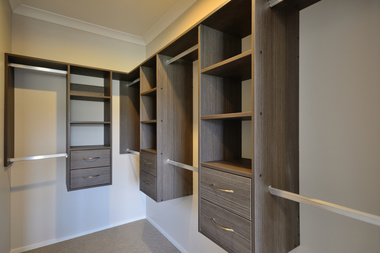
Organizing A His-and-Her Shared Walk-In Closet


It is possible to keep your his-and-her closet organized and still speak to one another. Here are some of our favorite products to help you get organized without causing a fight.
Focus on footwear
She doesn't have to sacrifice displaying her shoe collection in order to make room for his sneaker addiction. How? Get custom-made shoe shelves to keep shoes out of the way. Or try a shoe turntable that holds up to 25 pairs.
Don’t get tangled
Line drawers with felt to make it easy to find necklaces and bracelets, and prevent them from tangling, too. If you don’t have drawer space, try hanging your jewelry. Pottery Barn's fabric-lined mirrored wall-mounted jewelry closet is multifunctional—it’s a jewelry box, a mirror and a piece of art.
Tie it up
Men just can’t complain about women’s shoes without getting off the hook. Many men have their ties in disarray. Keep them organized with Rev-A-Shelf's Classic Wood Pull Out Tie Rack. It holds up to 120 ties!
Bag it
Is your partner annoyed with you as you frantically search for your matching bag? Make it easier by storing them in divided compartments, with each compartment containing bags of the same color or size. No room for compartments, add chrome shelf dividers to make individual homes for your purses.
For more home organization tips, give us a call today!

Friday, January 3, 2020

Why a Home Works for You


Equity in a home is the difference between what the home is worth and what is owed on the home.  As the property goes up in value, the unpaid balance is going down with each payment being made.  These dynamics are working in different directions to make the equity grow.

Leverage, the use of borrowed funds to control the investment, is another dynamic working in favor of homeowners. $9,975 invested in a certificate of deposit at 2% for three years would be worth $10,586.  The same amount invested in the stock market at 7% would be worth $12,220.  Using the same $9,975 to purchase a $285,000 home that appreciates at 2%* annually would have an equity at the end of three years of $41,350.  All three examples have compound growth but only the home uses borrowed funds.

Buying a home requires money for a down payment and closing costs, good credit and the income to pay back the loan.  Even if a person has all three of these requirements, sometimes, they are not sure if it makes sense to buy rather than rent.  A Rent vs. Own comparison can show you the financial advantages without considering the tax benefits.

Most homeowners will say that their home is the best investment they have made.  Not only in the satisfaction of owning their own home, where they can raise their family and a place to share with friends but also as a strong financial decision.

Thursday, January 2, 2020

The 2020 Real Estate Projections That May Surprise You


This will be an interesting year for residential real estate. With a presidential election taking place this fall and talk of a possible recession occurring before the end of the year, predicting what will happen in the 2020 U.S. housing market can be challenging. As a result, taking a look at the combined projections from the most trusted entities in the industry when it comes to mortgage rates, home sales, and home prices is incredibly valuable – and they may surprise you.

Mortgage Rates

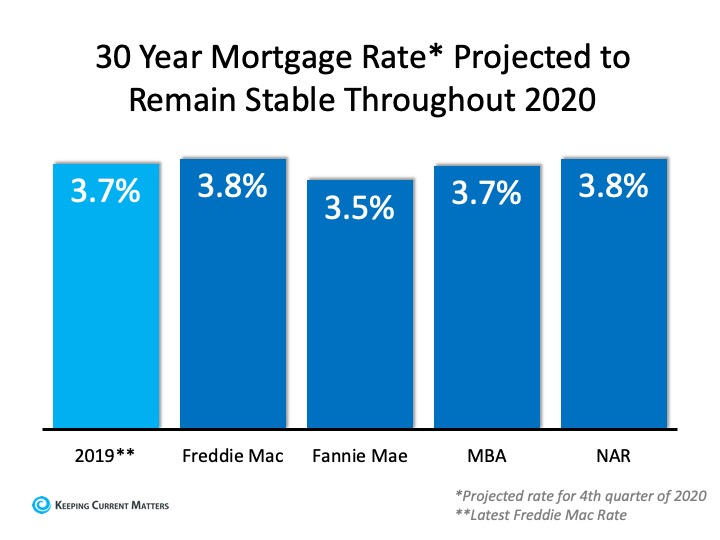
Projections from the experts at the National Association of Realtors (NAR), the Mortgage Bankers Association (MBA), Fannie Mae, and Freddie Mac all forecast mortgage rates remaining stable throughout 2020:The 2020 Real Estate Projections That May Surprise You | Keeping Current MattersSince rates have remained under 5% for the last decade, we may not fully realize the opportunity we have right now.
Here are the average mortgage interest rates over the last several decades:
  • 1970s: 8.86%
  • 1980s: 12.70%
  • 1990s: 8.12%
  • 2000s: 6.29%

Home Sales

Three of the four expert groups noted above also predict an increase in home sales in 2020, and the fourth sees the transaction number remaining stable:The 2020 Real Estate Projections That May Surprise You | Keeping Current MattersWith mortgage rates remaining near all-time lows, demand should not be a challenge. The lack of available inventory, however, may moderate the increase in sales.

Home Prices

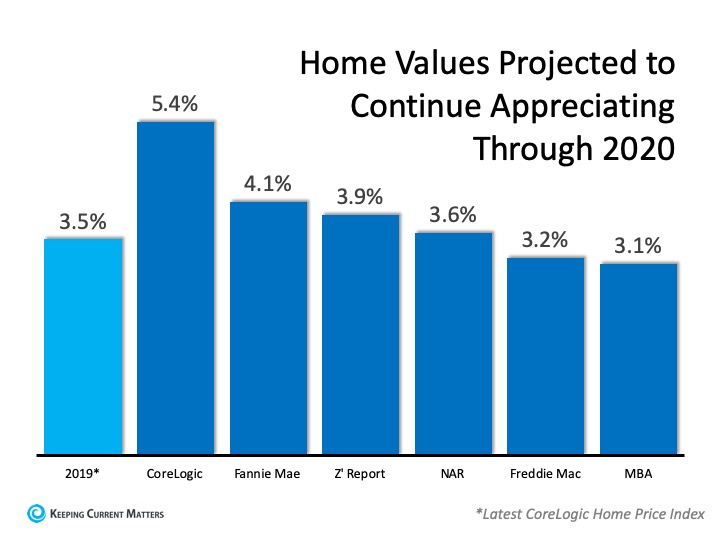
Below are the projections from six different expert entities that look closely at home values: CoreLogic, Fannie Mae, Ivy Zelman’s “Z Report”, the National Association of Realtors (NAR), Freddie Mac, and the Mortgage Bankers Association (MBA).The 2020 Real Estate Projections That May Surprise You | Keeping Current MattersEach group has home values continuing to improve through 2020, with four of them seeing price appreciation increasing at a greater pace than it did in 2019.

Is a Recession Possible?

In early 2019, a large percentage of economists began predicting a recession may occur in 2020. In addition, a recent survey of potential home purchasers showed that over 50% agreed it would occur this year. The economy, however, remained strong in the fourth quarter, and that has caused many to rethink the possibility.
For example, Goldman Sachs, in their 2020 U.S. Outlook, explained:
“Markets sounded the recession alarm this year, and the average forecaster now sees a 33% chance of recession over the next year. In contrast, our new recession model suggests just a 20% probability. Despite the record age of the expansion, the usual late-cycle problems—inflationary overheating and financial imbalances—do not look threatening.”

Bottom Line

Mortgage rates are projected to remain under 4%, causing sales to increase in 2020. With growing demand and a limited supply of inventory, prices will continue to appreciate, while the threat of an impending recession seems to be softening. It looks like 2020 may be a solid year for the real estate market.

Tuesday, December 31, 2019

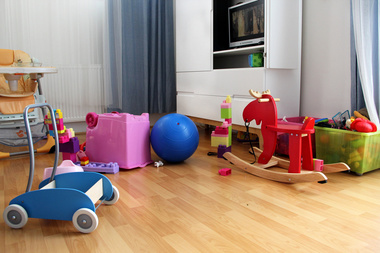
Children's Rooms Through the Years


Here are some tips on changing room decorations over the years.

Nursery
  • The key to longevity is keeping the essentials basic (e.g., beds, dressers, side tables) and decorating with temporary things. For example: White or mint-colored walls provide a basic pastel backdrop; you can then swap out knickknacks, wall photos and mobiles as your child grows up.
  • You can choose a theme or add a few prints and patterns in places, such as with the bed linens.
  • Keep colors gender neutral so your children can vary how masculine and feminine they want to decorate as they grow up, or easily swap rooms with a sibling.
  • Monochrome themes are sleek, but make it interesting with varied textures, wood accents and fun wallpapers.
  • Storage boxes are a must for storing baby care supplies and, later, toys. Consider buying a vintage or secondhand dresser for decorative storage.
Child's room
  • Involve your child: Bring in his or her favorite colors, hobbies and inspirations! Think of how to incorporate travels, comics, celebrity role models and your kid's dreams.
  • Swap out baby accessories for items for older kids.
  • Keep things simple; kids love to change their minds, so let their decorations bring the color and texture to the room.
  • Removable wall stickers let your kid change the walls easily and inexpensively.
  • A bedside light will let a child read before going to sleep and help him or her find the bathroom in the middle of the night.
  • Drape some string lights across the room for a cozy look.
  • When there are multiple kids to a room, keep the walls and furniture simple to reduce visual clutter; bring out each person's distinct personality but aim for complementary designs.
  • Storage is a must: Keep it at the edge of the room and leave space in the center for play. To encourage kids' tidiness, ensure storage is nearby and at their height.
  • Here are some fun features most kids love: a blackboard wall, a loft bedroom (if possible) or glow-in-the-dark painted stars on the ceiling.
  • Let your kids help out in the decorating; afterwards, they'll love their rooms!
Teen's room
  • A desk is a necessity for studying, as well as a place to spend free time online.
  • Storage is still essential, so make sure it's something he or she wants to use.
  • Give your teen display space for pictures, postcards and collections — peel-and-stick cork is inexpensive and easy to use.
Personal space is important, so let your teen decorate after you install the basic furniture.

Monday, December 30, 2019

Why You Shouldn’t “For Sale By Owner”


Rising home prices coupled with the current inventory in today’s market may cause some homeowners to consider selling their homes on their own (known in the industry as a For Sale By Owner). However, a FSBO might be hard to execute well for the vast majority of sellers.

Here are the top 5 reasons not to FSBO:

1. Online Strategy for Prospective Purchasers
Studies have shown that 93% of buyers search online for a home. That’s a pretty staggering number! Most real estate agents have an Internet strategy to promote the sale of your home. Do you?
2. Results Come from the Internet
According to NAR, here’s where buyers found the homes they actually purchased:
  • 55% on the Internet
  • 28% from a Real Estate Agent
  • 10% Other
  • 6% from a Yard Sign
  • 1% from Newspapers
The days of selling your house by putting up a sign in your yard or placing an ad in the paper are long gone. Having a strong Internet strategy is crucial.
3. There Are Too Many People to Negotiate With
Here’s a list of some of the people with whom you must be prepared to negotiate if you decide to FSBO:
  • The buyer, who wants the best deal possible
  • The buyer’s agent, who solely represents the best interest of the buyer
  • The buyer’s attorney (in some parts of the country)
  • The home inspection companies, which work for the buyer and will almost always find some problems with the house
  • The appraiser, if there is a question of value
4. FSBOing Has Become Increasingly Difficult
The paperwork involved in buying or selling a home has increased dramatically as industry disclosures and regulations have become mandatory. This is one of the reasons the percentage of people FSBOing has dropped from 19% to 8% over the last 20+ years.
5. You Net More Money When Using an Agent
Many homeowners believe they’ll save the real estate commission by selling on their own, but the seller and buyer can’t both save the commission.
A report by Zillow revealed that FSBOs are inclined to do so because they believe it will save money (46 percent cite this among their top three reasons), but they don’t actually save anything, and eventually end up listing with an agent.
The same report revealed that,
“While 36% of sellers that (at first) attempted to sell their homes on their own, only 11 percent of sellers—in other words, less than a third…actually sold without an agent.”
It appears working with a real estate professional is the best answer.

Bottom Line

Before you decide to take on the challenges of selling your house on your own, reach out to a local real estate professional to discuss your needs.

Friday, December 27, 2019

What's Keeping Buyers Out of the Market


60% of buyers paid for their down payment by saving according to the 2019 Profile of Home Buyers and Sellers, recently released in San Francisco at the National Association of REALTORS Convention.  The most difficult step in the process was saving for a down payment cited by 13% of respondents.

51% of those surveyed mentioned student loans as the main deterrent to saving.  Credit card debt was mentioned by 45% which is up from 37% in 2018.  Car loans were stated by 38% which is up three percentage points from the previous year.

Childcare was cited by 16% of the people which was one percentage point less than 2018.
The median years of debt delayed home buyers from saving for their down payment or buying a home was stated as four years.  That is up from three years mentioned by buyers in 2018.

Thursday, December 26, 2019

Anticipating the Cost of a Home


The largest expenditure a buyer has when purchasing a home is the down payment which can range from zero for veterans or 3.5%, 5%, 10% and 20%.  With mortgages come closing costs which can be another 2-4% and must be paid at settlement in cash.

Most mortgages require an escrow account to pay the property taxes and insurance when they are due.  Generally, the lender will require one to three months of taxes and one month of insurance so they can be paid before the actual due date.

First-time buyers should be aware that they'll need this amount of funds available to purchase a home.  Unlike tenants who are not responsible for repairs, homeowners are, and it is necessary to be able to pay for them when they're needed.

Newer homes will need less repairs and older homes probably, more.  At some point, components like the furnace, air-conditioner and appliances will need to be replaced which could crush a homeowner's budget if they are not expecting them.

Homeowners should expect between one and four percent of the value of the home in annual repairs.  The age and condition of the home and whether some of the items have been replaced will help assess the anticipated expenditures.  

Components
Estimated Life
Dishwasher
9-10 years
Refrigerator
13 years
Furnace
15-25 years
Air-conditioner
8-15 years
Stove top
13-15 years
Oven
15 years
Compactors
6 years
Water heater
8-12 years
Faucets
15-20 years

A $175,000 home with 2% estimated repair expenditures would be $3,500 a year or about $300 per month.  Some years, it may not run that much and other years, it might be more.  By anticipating the maintenance expenses, a homeowner is more likely to handle things when they arise.

Another way to handle the risk of unexpected repair expenses would be to purchase a home warranty.  For $500 -700 a year, repairs and sometimes, replacements will be handled by the protection plan.