Showing posts with label Home Buyers. Show all posts

Thursday, January 2, 2020

The 2020 Real Estate Projections That May Surprise You


This will be an interesting year for residential real estate. With a presidential election taking place this fall and talk of a possible recession occurring before the end of the year, predicting what will happen in the 2020 U.S. housing market can be challenging. As a result, taking a look at the combined projections from the most trusted entities in the industry when it comes to mortgage rates, home sales, and home prices is incredibly valuable – and they may surprise you.

Mortgage Rates

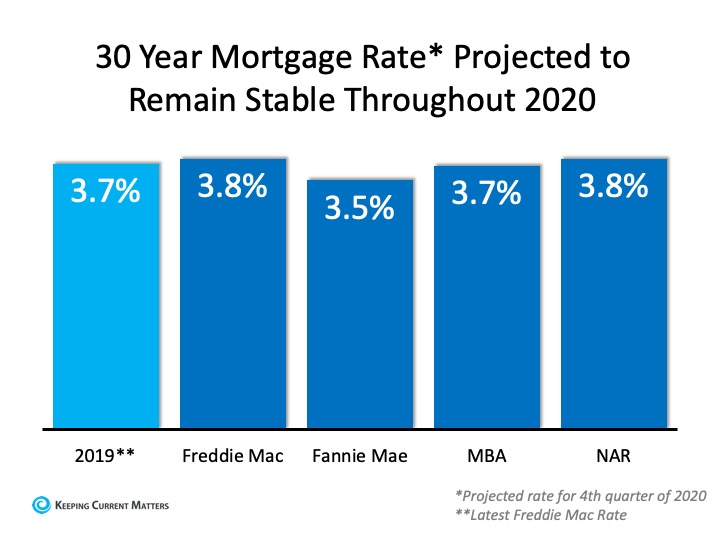
Projections from the experts at the National Association of Realtors (NAR), the Mortgage Bankers Association (MBA), Fannie Mae, and Freddie Mac all forecast mortgage rates remaining stable throughout 2020:The 2020 Real Estate Projections That May Surprise You | Keeping Current MattersSince rates have remained under 5% for the last decade, we may not fully realize the opportunity we have right now.
Here are the average mortgage interest rates over the last several decades:
  • 1970s: 8.86%
  • 1980s: 12.70%
  • 1990s: 8.12%
  • 2000s: 6.29%

Home Sales

Three of the four expert groups noted above also predict an increase in home sales in 2020, and the fourth sees the transaction number remaining stable:The 2020 Real Estate Projections That May Surprise You | Keeping Current MattersWith mortgage rates remaining near all-time lows, demand should not be a challenge. The lack of available inventory, however, may moderate the increase in sales.

Home Prices

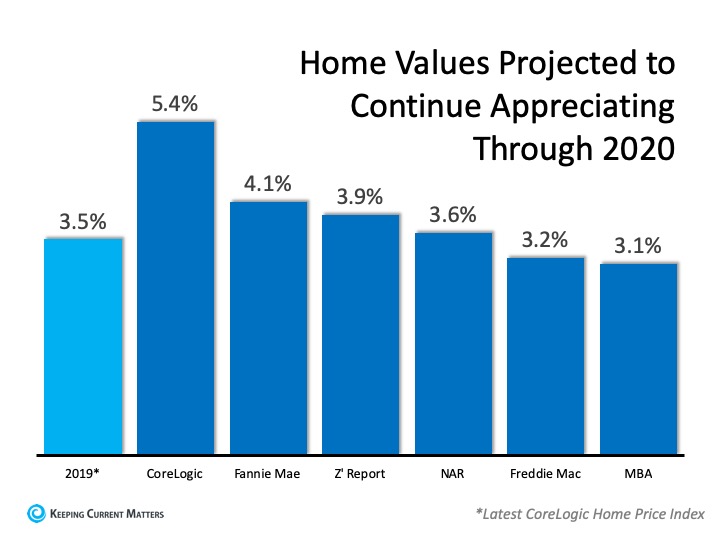
Below are the projections from six different expert entities that look closely at home values: CoreLogic, Fannie Mae, Ivy Zelman’s “Z Report”, the National Association of Realtors (NAR), Freddie Mac, and the Mortgage Bankers Association (MBA).The 2020 Real Estate Projections That May Surprise You | Keeping Current MattersEach group has home values continuing to improve through 2020, with four of them seeing price appreciation increasing at a greater pace than it did in 2019.

Is a Recession Possible?

In early 2019, a large percentage of economists began predicting a recession may occur in 2020. In addition, a recent survey of potential home purchasers showed that over 50% agreed it would occur this year. The economy, however, remained strong in the fourth quarter, and that has caused many to rethink the possibility.
For example, Goldman Sachs, in their 2020 U.S. Outlook, explained:
“Markets sounded the recession alarm this year, and the average forecaster now sees a 33% chance of recession over the next year. In contrast, our new recession model suggests just a 20% probability. Despite the record age of the expansion, the usual late-cycle problems—inflationary overheating and financial imbalances—do not look threatening.”

Bottom Line

Mortgage rates are projected to remain under 4%, causing sales to increase in 2020. With growing demand and a limited supply of inventory, prices will continue to appreciate, while the threat of an impending recession seems to be softening. It looks like 2020 may be a solid year for the real estate market.

Thursday, September 26, 2019

Homeowners Are Happy! Renters? Not So Much.


When people talk about homeownership and the American Dream, much of the conversation revolves around the financial benefits of owning a home. However, two recent studies show that the non-financial benefits might be even more valuable.

In a recent survey, Bank of America asked homeowners: “Does owning a home make you happier than renting?” 93% of the respondents answered yes, while only 7% said no. The survey also revealed:
  • More than 80% said they wouldn’t go back to renting
  • 88% agreed that buying a home is the “best decision they have ever made”
  • 79% believed owning a home has changed them for the better
Those surveyed talked about the “emotional equity” that is built through homeownership. The study says more than half of current homeowners define a home as a place to make memories, compared to 42% who view a home as a financial investment. Besides building wealth, the survey also showed that homeownership enhances quality of life:
  • 67% of current homeowners believed their relationships with family and loved ones have changed for the better since they bought a home
  • 78% are satisfied with the quality of their social life
  • 82% of homeowners said they were satisfied with the amount of time they spend on their hobbies and passions since purchasing a home
  • 75% of homeowners pursued new hobbies after buying a home
Homeowners seem to be very happy.

Renters Tell a Different Story…

According to the latest Zillow Housing Aspirations Report, 45% of renters regret renting rather than buying — more than five times the share of homeowners (8%) who regret buying instead of renting. Here are the four major reasons people regret renting, according to the report:
  • 52% regret not being able to build equity
  • 52% regret not being able to customize or improve their rentals
  • 50% regret that the rent is so high
  • 49% regret that they lack private outdoor space
These two studies prove that renting is just not the same as owning.

Bottom Line

There are both financial and non-financial benefits to homeownership. As good as the “financial equity” is, it doesn’t compare to the “emotional equity” gained through owning your own home.

Wednesday, June 26, 2019

Before You Look for Your Dream Home: Know What You Want vs. What You Need!


In this day and age of being able to shop for anything anywhere, it is really important to know what you’re looking for when you start your home search.


If you’ve been thinking about buying a home of your own for some time now, you’ve probably come up with a list of things that you’d LOVE to have in your new home. Many new homebuyers fantasize about the amenities that they see on television or Pinterest, and start looking at the countless homes listed for sale through rose-colored glasses.


Do you really need that farmhouse sink in the kitchen to be happy with your home choice? Would a two-car garage be a convenience or a necessity? Could the “man cave” of your dreams be a future renovation project instead of a make-or-break right now?
The first step in your home buying process should be getting pre-approved for your mortgage. This allows you to know your budget before you fall in love with a home that is way outside of it.

The next step is to list all the features of a home that you would like, and to qualify them as follows:
  • “Must-Haves” – if this property does not have these items, then it shouldn’t even be considered (ex: distance from work or family, number of bedrooms/bathrooms).
  • “Should-Haves” – if the property hits all of the ‘must-haves’ and some of the ‘should-haves,’ it stays in contention but does not need to have all of these features.
  • “Absolute-Wish List” – if we find a property in our budget that has all of the ‘must-haves,’ most of the ‘should-haves,’ and ANY of these, it’s the winner!

Bottom Line

Having this list fleshed out before starting your search will save you time and frustration. It also lets your agent know what features are most important to you before they start showing you houses in your desired area.

Tuesday, June 25, 2019

Planting an Edible Garden


While flower gardens are beautiful and peaceful, homeowners today are increasingly interested in planting small-scale edible gardens. The resulting produce may be better tasting than anything you can get in a supermarket. While you aren't likely to create a sustainable farm, you can have access to fresh produce straight from the garden whenever it's ready to harvest. From leafy greens to herbs and from fruits to vegetables, what you put into an edible garden is exactly what you get it out of it. Here are some tips on planting an edible garden.
The Style of Your Edible Garden
If you plan to sell your home in the future, it's especially important to pay attention to the style of your garden. For example, some people create an edible garden around already existing flower beds in their yard. Or they may use raised beds or pots if they're concerned about the impact of planting on their lawn.
Some cities allow homeowners to have a vegetable garden in their front yard. If that is a part of the culture of your city, it could be seen as a benefit for future resale. Before you plant anything, decide how you want it to look now and in the future.
What to Plant in Your Edible Garden
As long as you can eat it and it can grow in your climate, anything is possible in an edible garden. Popular home garden plants include:
  • Tomatoes.
  • Herbs.
  • Peppers.
  • Potatoes.
  • Carrots.
If you have the yard for it, consider planting a fruit or nut tree. These take a longer time before your first harvest, but there's nothing like apples fresh off the tree in the fall.
Soil and Sun Considerations
You'll need to take into account the amount and timing of the sunlight in your yard to determine how to plant your edible garden. Different plants require different levels and hours of sunlight, so start tracking how the sun hits your property throughout the day during the summer.
You may also want to evaluate your soil and supplement it with additional nutrients if it isn't conducive to growing things. An issue with your soil is also a great reason to consider using raised beds or pots, because they allow you to choose whatever type of soil you need.
Involve the Whole Family 
The idea of planting an edible garden is to enhance your life. It's a great activity for all ages, and you can get the entire family involved. Everyone can have a job, no matter how young or old. Gardening together can be a great bonding experience for the whole family.
You also get the satisfaction of your harvest. You can share your bounty with friends and neighbors, especially if you plant more than you can use before it spoils. Edible gardens pay for themselves very quickly.
Do you want more tips on growing an edible garden for you home? Contact us today.

Thursday, June 6, 2019

What is Important to Boomers when Selling their House?


If you are a “baby boomer” (born between 1946 and 1964), you may be thinking about selling your current home. Your children may have finally moved out. Your large, four-bedroom house with three bathrooms no longer fits the bill. Taxes are too high.

Utilities are too expensive. Cleaning and repair are too difficult. You may be ready to move into a home that better fits your current lifestyle. Many fellow boomers have already made the move you may be considering.

The National Association of Realtors recently released their 2019 Home Buyer and Seller Generational Report. The report revealed many interesting tidbits about both categories of baby boomers: younger boomers (ages 54 to 63) and older boomers (64 to72). Here are a few of the more interesting topics.

Percentage of Buyers who Looked Online First

  • All Buyers: 44%
  • Younger Boomers: 46%
  • Older Boomers: 44%

Where Boomers Found the Home They Purchased

The two major ways buyers found the home they purchased:
  • All buyers: 50% on the internet, 28% through a real estate agent
  • Younger Boomers: 46% on the internet, 33% through a real estate agent
  • Older Boomers: 36% on the internet, 35% through a real estate agent

Distance Seller Moved

The distance between the home they purchased and the home they recently sold was much greater for boomers than the average seller.
  • All sellers: 20 miles
  • Younger Boomers: 27 miles
  • Older Boomers: 50 miles

Tenure in Previous Home of Seller

The percentage of older boomers who lived in their previous home for more than 20 years was almost twice the amount of the average seller.
  • All sellers: 16%
  • Younger Boomers: 20%
  • Older Boomers: 31%

Primary Reason to Sell their Previous Home

  • Want to move closer to friends or family
  • Home too large
  • Retirement

View of Homeownership as a Financial Investment

  • 83% of Younger Boomers see homeownership as a good investment
  • 82% of Older Boomers see homeownership as a good investment

Bottom Line

If you are a boomer and thinking about selling, now might be the time to contact an agent to help determine your options.

Tuesday, June 4, 2019

5 Lawn Care Mistakes That Can Destroy Your Yard


Everyone wants a lawn covered with lush green grass and verdant plants. But what mistakes are preventing you from achieving this? Read on to learn about some common lawn care mistakes and how to prevent them.


1. Cutting Grass Too Short
Experts advise cutting off no more than 30 percent of the grass blade in a single pass. Cutting your grass too short or trimming it down to half of its previous size might be appealing—after all, if your grass is shorter, it will take longer to grow back—but this is not good for the long-term health of your lawn.
In addition to damaging the blade, cutting your grass too short can indirectly damage the root system. This damage will limit the grass's ability to collect light and absorb water, leading to wilting or even plant death. Keeping your grass longer will help it to grow fuller and become more lush.

2. Using Only One Type of Seed
Using a mixture of seeds will result in a mixture of plant types. Different types of grass will survive better in different conditions. The different species will balance out each other's strengths and weaknesses, resulting in a more resilient lawn overall. This will make your turf more likely to survive extreme weather conditions such as prolonged heat or drought.

3. Ignoring the pH of the Soil
The optimal pH for grass is between 6.0 and 6.5. For reference, a neutral pH, such as that of water, is 7.0. This means that your lawn's soil should be slightly acidic in order to bolster plant growth. Sending away a soil sample for testing can be an easy way to get a gage on your lawn's pH. If the pH is out of whack, it can easily be adjusted using sulfur or lime treatments.

4. Forgetting to Sharpen Your Lawn Mower's Blade
A sharp blade will cut your grass more cleanly, while a dull blade can cause bruising and other damage to each blade of grass. Damaged blades of grass are more susceptible to death or disease, so using a sharp lawn mower blade can contribute to the overall health of your lawn.

Most people should sharpen their lawn mower blades approximately twice a year. A good sign that your blade is too dull is that your lawn mower is tearing or crushing your grass instead of cutting it cleanly.

5. Collecting Grass Clippings
Many lawn mowers come with an attached bag that will gather up the grass as it is cut. This is a visually appealing strategy, but it is not good for your lawn's long-term health. Instead, you should leave the grass clippings spread around your lawn. This self-mulching strategy will help fertilize your remaining grass. In particular, this is useful in maintaining your soil's nitrogen levels—a key factor in lawn health.


If you can avoid making these 5 common lawn care mistakes, you will enjoy a lush, green lawn throughout the year.

Friday, May 24, 2019

The Impact Staging Your Home Has On Your Sale Price


Some Highlights:

  • The National Association of Realtors surveyed their members & released the findings of their Profile of Home Staging.
  • 62% of seller’s agents say that staging a home decreases the amount of time a home spends on the market.
  • 50% of staged homes saw a 1-10% increase in dollar-value offers from buyers.
  • 77% of buyer’s agents said staging made it easier for buyers to visualize the home as their own.
  • The top rooms to stage in order to attract more buyers are the living room, master bedroom, kitchen, and dining room.

Thursday, May 23, 2019

2019 Colors of the Year


It’s that fun time of the year where us paint color geeks look forward to the paint manufacturers announcing their annual “Colors of the Year”.  Most of the manufacturers have announced their colors in the last couple of weeks and today I’m excited to share the 2019 Colors of the Year with you from Sherwin Williams, BEHR, Ace’s Clark + Kensington, PPG and Dutch Boy.

Tuesday, May 21, 2019

Are Older Generations Really Not Selling Their Homes?

Many studies suggest one of the main reasons for the inventory shortage in today’s market of homes for sale is that older generations have chosen to “age in place” over moving.

The 2019 Home Buyers & Sellers Generational Trend Report by NAR clarifies this point!

NAR’s findings show that Baby Boomers (43%) and the Silent Generation (12%) made up 56% of sellers in 2018! This means the majority of sellers last year were over the age of 54. This also shows these generations ARE moving!

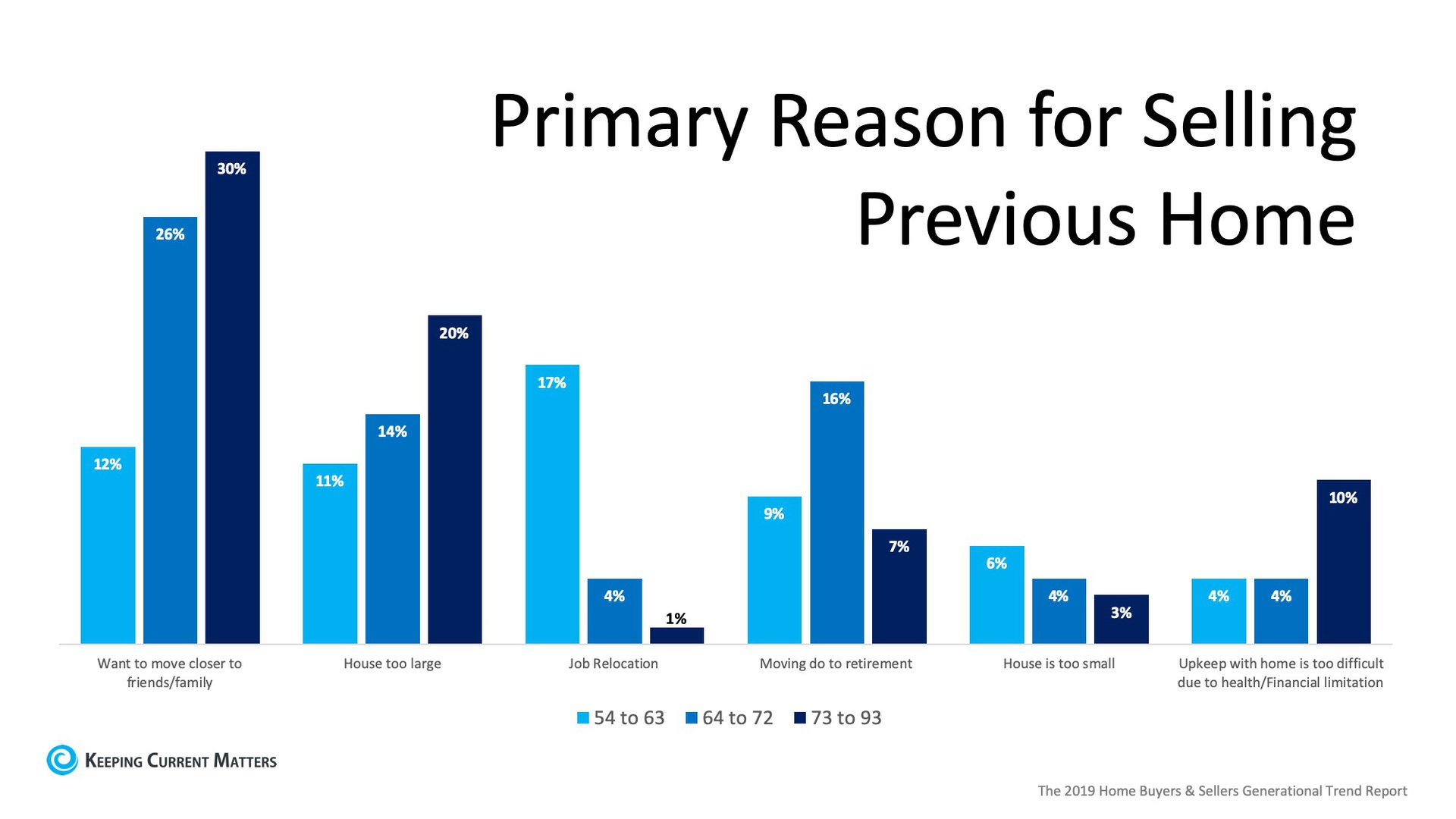
The report also shared the reasons why they chose to move. According to the research, the top reason was a desire to be closer to friends and family. Below is a full breakdown:
Are Older Generations Really Not Selling their Homes? | Keeping Current Matters
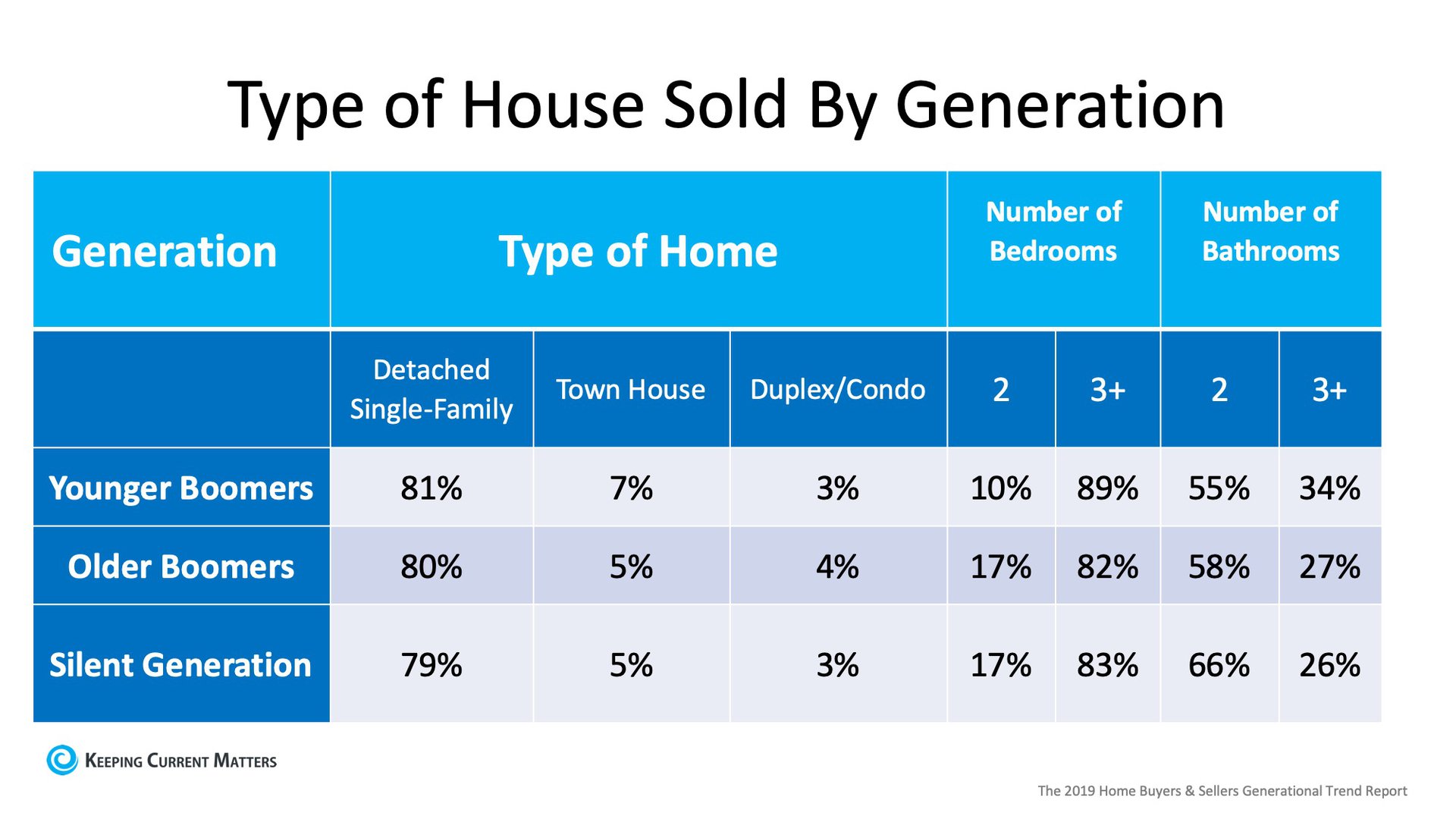
As we can see, they have plenty of reasons to sell their current home! But what type of homes are they trading in?Are Older Generations Really Not Selling their Homes? | Keeping Current Matters
Once again, the report demonstrated that older generations are not keeping that 3-bedroom, 2-bath colonial home. Instead, they are putting it on the market and moving on with their lives!

Bottom Line

If you are living in a house that no longer fits your needs, contact a local real estate professional who can help you find a home that will!

Tuesday, June 20, 2017

Your Road to Buying A VA Home


Vets, you've served our great country, and it is only right that you have a piece of America: The Road to Buying a VA Home #Veterans http://timgrissett.com

Wednesday, April 5, 2017

Buying this Spring? Be Prepared for Bidding Wars


Traditionally, spring is the busiest season for real estate. Buyers come out in force and homeowners list their houses for sale hoping to capitalize on buyer activity. This year will be no different! Buyers have already been out in force looking for their dream homes and more are on their way, but the challenge is that the inventory of homes for sale has not kept up with demand, which has lead to A LOT of competition for the homes that are available. A recent Bloomberg article touched on the current market conditions:
“It’s the 2017 U.S. spring home-selling season, and listings are scarcer than they’ve ever been. Bidding wars common in perennially hot markets like the San Francisco Bay area, Denver and Boston are now also prevalent in the once slow-and-steady heartland, sending prices higher and sparking desperation among buyers across the country.”
Sam Khater, Deputy Chief Economist at CoreLogic went on to explain why buyers are flocking to the market in big numbers:
“In today’s market, many buyers think the trough in [interest] rates is over. If you don’t get in now, it’s just going to be worse later. Rates will be higher, prices will be higher, and maybe inventory selection will be lower.”
In some markets, “thirty-five percent of properties are selling within the first week or two of hitting the market.” Homes are selling at a rapid clip in places like:
  • Denver, CO
  • Seattle, WA
  • Oakland, CA
  • Grand Rapids, MI
  • Boise, ID
  • Madison, WI
  • Omaha, NE

Bottom Line

In today’s competitive atmosphere, you need a professional on your side who knows your exact market conditions and can help you take the steps you need to be able to secure your new home!

Friday, March 24, 2017

How Low Supply & High Demand Impacts the Real Estate Market


How Low Supply & High Demand Impacts the Real Estate Market: The concept of Supply & Demand is a simple one. The best time to sell something is when the supply of that item is low & the demand for that item is high! Anything under a 6-month supply is a Seller’s Market! There has not been a 6-months inventory supply since August 2012! Buyer Demand continues to outpace Seller Supply!

Thursday, March 16, 2017

Smart Ways to Pay Off Your Mortgage Early


It's a goal as cherished as early retirement. Everyone who buys a home for keeps dreams of the day they make their last house payment. Sadly, the majority of homeowners in the U.S. never even get close. However, there are some smart ways, some tried and true, some you may not have thought about, that will allow you to pay off your mortgage early.

Old-fashioned methods can work. The difficulty is disciplining yourself to actually follow through. Step one to paying off your mortgage early is to make a plan. Keep in mind that Rome wasn't built in a day and you are not going to pay off your mortgage in a few months, maybe not even in a couple of years. But here are some smart ways to go about paying off early.

Make Savings Automatic. Saying you are setting aside $200 per month for your payoff amount (above and beyond your regular monthly payments) sounds good, but it only works if you actually do it. Open up a savings account just for your remaining balance, and make that monthly percentage automatic.

Put Extra Away. Saving every month is a great start. But when you get that income tax refund, instead of going on a shopping spree, put it in your payoff savings account. Any extra money — a bonus, a lottery ticket win, a small inheritance — should all largely go to your payoff savings account.

Ditch the Waste. All work and no play makes you a very dull boy or girl, so ditching the waste doesn't mean cutting off your cable, although that could add up to a couple thousand dollars a year. It means buy some Folgers instead of stopping at Starbucks every morning for a cup of Joe.

Think about it; $4 a day, five days a week, for 52 weeks each year. That's over a thousand dollars a year just for a cup of coffee you could make at home for a few cents a week. Here are some other wasteful expenses you can ditch and how much you could save each year.
  • Your Unused Gym Membership – or even your used one — is $40 or $50 dollars a month. That adds up over time. You can exercise at home for free, and modest home equipment will pay for itself.
  • The Latest Gadgets – Changing your cell phone plan alone can save you around $100 per month.
  • Cook a Meal – Fast food, the movies, sit-down restaurants — they all eat up $100 a week out of your budget. That's right, you're talking potentially over $5,000 per year you could be saving just by eating in and streaming a movie instead of paying $15 per ticket at the box office.
  • Carpool and Walk – If your corner store is literally down the street, walk or ride a bike, don't drive. When you go to work, find a carpool. You'll be surprised how much money you can save on transportation with just those two ideas.

Wednesday, March 8, 2017

How Long Does It Take to Buy a House?

Find out the amount of time each step in the home buying process typically takes.

Buying a home generally takes two to three months, depending on factors including your credit, how long lender approval takes, and the act of searching for the right property. “It varies, but on average it takes between 30 and 45 days to buy a home,” said Nadeem Qureshi, real estate agent at Champions Real Estate Group.
 
The process of buying a house can be broken down into six steps, each of which takes a relatively predictable amount of time.

1. Fix Credit Report Errors Before You Buy a House: 8 Weeks

“Before you can consider purchasing a home or securing a mortgage, you need to make sure your credit is good,” said Qureshi. What’s considered good is subjective. The FHA currently offers loans with just 3.5 percent down for people with scores of at least 580, but that score might be too low to qualify for a conventional loan.
Credit scores are based on factors like credit usage and history of on-time payments. Mistakes in your report can sink your chances for a good interest rate, or even prevent you from being qualified. Order a credit report early in the house-buying process and search for errors to challenge. All three credit bureaus — TransUnion, Equifax and Experian — respond to disputes within 30 days. From there it takes another month for the changes to reflect.
 

2. Get Mortgage Preapproval or Mortgage Prequalification: 18 Days

“Smart shoppers will seek loan pre-approval prior to beginning their search for a home,” said Jason Haynes, broker associate at Century 21 Stopper & Associates. “I have a mortgage broker who I routinely work with, and given all the necessary information and paperwork, loan pre-approval can take less than 48 hours.”
According to CBS, however, that scenario is rare. Pre-approval requires borrowers to submit detailed, accurate records related to their finances, credit history, income, assets and debt for review by loan officers and underwriters.
That can happen in two or three days, or as many as 45 days, but those timelines are outliers. The average is about 18 days from the start of the process to finish.

3. Find a Real Estate Agent: 1 to 30 Days

“There is no real method to choosing an agent,” Haynes said. “I’ve been told I was chosen because I ‘looked like a nice guy on the website.’ Plus, picking an agent can take only a few minutes in the online world.”
 
But spending a few weeks researching can’t hurt — especially if you’re buying your first home. Buyers need to trust their agents and vet them to ensure they’re diligent, competent and honest.
Get references from friends and family, and hire someone local with intimate knowledge of the area in which you want to buy. Ask questions like:
  • How long have you been in the business?
  • Is real estate your full-time job?
  • How many buyers do you work with at once, on average?

4. Research Potential Houses and Neighborhoods: 3 Weeks

“Searching for homes has become much more streamlined,” said Haynes. “With websites such as Zillow.com and Trulia.com, buyers can often create a short list of properties before reaching out to an agent.” Sites like these can be used to filter specific search parameters and help estimate the expenses associated with closing on a house.
“It’s a good idea to break up your housing criteria into needs, wants and desires,” said Candy Miles-Crocker, associate broker at Long and Foster Real Estate, Inc. “Needs are those amenities that the buyer simply can’t live without. Wants are those amenities that would be nice. Desires are those amenities that would be over-the-top wonderful.”

5. Find the Right House and Make an Offer: Varies

“After the initial meeting, the realtor will send the buyer various listings that meet their criteria, and the buyer can decide if they would like to see any of the properties,” said Miles-Crocker. “But once the buyer finds a house that they love, the process moves extremely quickly.”
That process is different for everyone. “I’ve had had couples take one day and couples that take up to one year,” said Qureshi.
“Once the offer is written and signed by the buyer, the realtor will present the offer and the seller has three options: accept, reject or counter,” said Miles-Crocker.
How long does it take to close on a house? That depends a lot on the next step: the inspection.
 

6. Get a House Inspection: 1 Week

“A home inspection is the single most important thing you can invest in when purchasing your home,” said Daniel Garcia, realtor with RE/MAX. “The consumer and real estate agent can only see cosmetic defects while walking through a property, whereas a home inspector will conduct a thorough inspection.”
A home might seem great, but if it needs repairs or has any issues, you need to make sure it’s still worth your money, Garcia said.
An inspection will take up to three hours, but getting the inspector to the house can take up to one week. Most real estate agents can recommend an inspector with whom they frequently work, but buyers can select their own inspector.
The house-buying process is different for everyone, and the average time to buy a house varies by homebuyer. Almost without exception, however, buyers will encounter these six steps.

Wednesday, February 22, 2017

Thursday, February 16, 2017

Friday, February 10, 2017

5 Reasons to LOVE Using A Real Estate Professional

Hiring a real estate professional to guide you through the process of buying a home or selling your house can be one of the best decisions you make! We are there for you to help with paperwork, explaining the process, negotiations, and helping you with pricing (both when making an offer or setting the right price for your home). One of the top reasons to hire a real estate professional is our understanding of your local market and how the conditions in your neighborhood will impact your experience. timgrissett.com


Tuesday, February 7, 2017

Kitchens!

What do you think of this kitchen? Contact me today and let's see if I can help you find your dream kitchen and dream home!


Monday, February 6, 2017

15 vs 30 Year Fixed Rate Mortgage

The main differences between 15- and 30-year loans are straightforward. Fifteen-year loans have higher monthly payments, but you pay less interest, while 30-year terms have lower monthly payments, but you pay significantly more for the house in the long run.