Showing posts with label Mortgage. Show all posts

Tuesday, July 23, 2019

What Do I Need to Know About Mold?


There are few things that homeowners dread more than mold in the house. You’ve likely heard horror stories about people living with mold infestations that made them seriously ill. Is this just hype, or is there a real danger to having mold in your home? More importantly, what can you do if you find mold growing somewhere in the house?

What Is Mold?

Mold is a broad group of fungi, with thousands of species and subspecies around the world that typically prefer dark and damp habitats. Often fuzzy in appearance (though occasionally slimy or cottony), molds spread across materials and break them down to get the nutrients the mold needs to survive and thrive. Instead of seeds, molds release single-celled spores that in many cases are too small to see with the naked eye; these spores float through the air to land on a variety of surfaces, beginning growth once they find themselves in a suitable habitat. Though molds are made up of a number of individual stalks fibers, a connected clump of mold is considered to be a single living entity.

Types of Mold

There are several common types of mold that you might see around the house. While some of these may not be inherently dangerous, any mold can trigger reactions in anyone with an allergy or sensitivity. The five most common of these molds are:
  • Aspergillus: One of the most common indoor molds, it often appears green, blue-green or gray but can also appear white or even yellow.
  • Cladosporium: A black or green mold that has an appearance like ground pepper, it commonly grows on smooth surfaces like toilets and painted walls but can also grow in fabrics and rugs.
  • Ulocladium: A black mold that grows in wet areas, especially in cracks and corners; it is most common in homes with water damage and active leaks.
  • Aureobasidium: Varying in color from pink to brown or black, this mold most commonly grows behind wallpaper, on painted surfaces and on wood.
  • Stachybortrys: The infamous “black mold”, it features a slimy dark green or black color and thrives in areas that are damp and maintain high humidity for weeks.

Is Mold Actually Dangerous?

While many molds are allergens, most will not cause severe reactions unless you have a mold sensitivity or have other health problems that make you more prone to infection. However, some molds (such as black mold) actually are toxic and can make you very sick if you’re around them for too long. Symptoms of a mold allergy or toxic mold exposure can include a chronic cough, skin rashes, fatigue, difficulty focusing and even pain or infection in your sinuses, eyes and ears.

Mold Testing and Removal

If you suspect that you have mold problems, there are home tests available to help you identify the type of mold in your home. These should only be a first step, however, as they often aren’t enough to definitively show you the scope of your mold problem. Call in an expert to confirm the results of your test or take a scraping of the mold and have it analyzed. Be sure to wear a dust mask or other breathing protection if you aren’t sure what type of mold you’re dealing with until the problem is taken care of.

For many mold infestations, getting rid of leaks or other sources of humidity is a great way to slow or even stop mold growth. Mold can cause serious damage over time, however, so you may need professional mold removal and repair services if you can’t get the problem under control early.
Is your home in need of some serious mold removal?

Thursday, June 27, 2019

Know What to Expect at Your Home Inspection


So you made an offer and it was accepted. Now, your next task is to have the home inspected prior to closing. Agents oftentimes make your offer contingent on a clean home inspection.

This contingency allows you to renegotiate the price you paid for the home, ask the sellers to cover repairs, or in some cases, to walk away. Your agent can advise you on the best course of action once the report is filed.

How to Choose an Inspector

Your agent will most likely have a short list of inspectors that they have worked with in the past that they can recommend to you. HGTV recommends that you consider the following five areas when choosing the right home inspector for you:
1. Qualifications – find out what’s included in your inspection and if the age or location of your home may warrant specific certifications or specialties.
2. Sample Reports – ask for a sample inspection report so you can review how thoroughly they will be inspecting your dream home. In most cases, the more detailed the report, the better.
3. References – do your homework – ask for phone numbers and names of past clients who you can call to ask about their experiences.
4. Memberships – Not all inspectors belong to a national or state association of home inspectors, and membership in one of these groups should not be the only way to evaluate your choice. Membership in one of these organizations often means that continued training and education are provided.
5. Errors & Omission Insurance – Find out what the liability of the inspector or inspection company is once the inspection is over. The inspector is only human, after all, and it is possible that they might have missed something they should have seen.
Ask your inspector if it’s okay for you to tag along during the inspection. That way they can point out anything that should be addressed or fixed.
Don’t be surprised to see your inspector climbing on the roof or crawling around in the attic and on the floors. The job of the inspector is to protect your investment and find any issues with the home, including but not limited to: the roof, plumbing, electrical components, appliances, heating & air conditioning systems, ventilation, windows, the fireplace and chimney, the foundation, and so much more!

Bottom Line

They say, ‘ignorance is bliss,’ but not when investing your hard-earned money into a home of your own. Work with a professional who you can trust to give you the most information possible about your new home so that you can make the most educated decision about your purchase.

Wednesday, June 5, 2019

The Feeling You Get from Owning Your Home

We often talk about the financial reasons why buying a home makes sense. But, more often than not, the emotional reasons are the more powerful and compelling ones.

No matter what shape or size your living space is, the concept and feeling of home can mean different things to different people. Whether it’s a certain scent or a favorite chair, that feeling of safety and security you gain from owning your own home is simultaneously one of the greatest and most difficult to describe.


Frederick Peters, a contributor for Forbes, recently wrote about that feeling, and the pride that comes from owning your own home.
“As homeowners discover, living in an owned home feels different from living in a rented home. It’s not just that an owner can personalize the space; it touches a chord even more fundamental than that.
Homeownership enhances the longing for self-determination at the heart of the American Dream. First-time homeowners, young or old, radiate not only pride but also a sense of arrival, a sense of being where they belong. It cannot be duplicated by owning a 99-year lease.”

Bottom Line

Owning a home brings a sense of accomplishment and confidence that cannot be achieved through renting. If you are debating renewing your lease, meet with a local real estate professional first. They can help answer any questions you have about what your next steps should be and what is required in today’s market!

Friday, March 24, 2017

Why a Good Home Appraisal is Important

A good home appraisal is one of the most important components of getting approved for a mortgage. This appraisal ultimately decides just how much a bank is willing to lend to you, and a bad appraisal can kill your plans for a new home faster than a bad credit score. A home appraisal is the best way for a lender to see if they wont lose their seat on the deal.


The lender wants to make sure that they have an asset that they can sell to get their money back in case of default. The home appraisal is also a way for you to see if the home you are wanting is overpriced or not.

Lets say that John Doe wants to secure a mortgage on a home that cost $180,000. His credit score is very good, yet the home only appraises for $150,000.

Will John get his loan? You better believe he won't. The sale price will have to be lowered for the lender to consider to loan John the money. This is also a warning for John, that the home that he is trying to secure may be overpriced.

So what does an appraiser look for?
An appraisal usually starts with an inspection of the inside and outside of your home, as well as sale and ask prices for comparable homes in the area.The appraiser will create a report for the lender that includes:
  • An explanation of how the appraiser determined the value of the property
  • The size and condition of the house and other permanent fixtures, along with a description of any improvements that have been made and the materials used
  • Statements regarding serious structural problems, such as wet basements and cracked foundations
  • Notes about the surrounding area, such as new or established development, rural acreage, and so on
  • Evaluation of recent market trends of the area that may affect the value
  • Comparative market analysis that supports the appraisal: maps, photographs and sketches

An important thing to note is that, an appraiser is not a home inspector. An appraiser will make note of obvious issues but does not inspect the home to see if it is up to code. For this you will actually need to hire someone to do a home inspection to avoid any costly nightmares in the future if something is wrong with the house.

How much is this going to cost me?
Appraisals typically cost in the range of $300- $400. This price can change though depending on the location of the property, square footage of the home, or property type. The appraiser’s fees are usually included in the closing costs of the home, unless a deal on the property is not made.

Is it time to throw in the towel if the appraisal is too low?

First you need to see why the appraisal was low. It could be something that the homeowner could correct, or the home could be overpriced. If it is overpriced see if the homeowner would come down on their price. You can also request another appraisal on the home, keep in mind that you are the one paying for these appraisals.

As a seller what can you do to make up for a bad appraisal?

The first thing you need to do is see why it was appraised lower, it could be because of maintenance or repairs. If this is the case, you can get another appraisal after they have been fixed. Another way to increase the appraisal price is cosmetics, especially in an older home. New paint, appliances, carpet and replacement windows are all ways to add to the value of your home.

Thursday, March 16, 2017

Smart Ways to Pay Off Your Mortgage Early


It's a goal as cherished as early retirement. Everyone who buys a home for keeps dreams of the day they make their last house payment. Sadly, the majority of homeowners in the U.S. never even get close. However, there are some smart ways, some tried and true, some you may not have thought about, that will allow you to pay off your mortgage early.

Old-fashioned methods can work. The difficulty is disciplining yourself to actually follow through. Step one to paying off your mortgage early is to make a plan. Keep in mind that Rome wasn't built in a day and you are not going to pay off your mortgage in a few months, maybe not even in a couple of years. But here are some smart ways to go about paying off early.

Make Savings Automatic. Saying you are setting aside $200 per month for your payoff amount (above and beyond your regular monthly payments) sounds good, but it only works if you actually do it. Open up a savings account just for your remaining balance, and make that monthly percentage automatic.

Put Extra Away. Saving every month is a great start. But when you get that income tax refund, instead of going on a shopping spree, put it in your payoff savings account. Any extra money — a bonus, a lottery ticket win, a small inheritance — should all largely go to your payoff savings account.

Ditch the Waste. All work and no play makes you a very dull boy or girl, so ditching the waste doesn't mean cutting off your cable, although that could add up to a couple thousand dollars a year. It means buy some Folgers instead of stopping at Starbucks every morning for a cup of Joe.

Think about it; $4 a day, five days a week, for 52 weeks each year. That's over a thousand dollars a year just for a cup of coffee you could make at home for a few cents a week. Here are some other wasteful expenses you can ditch and how much you could save each year.
  • Your Unused Gym Membership – or even your used one — is $40 or $50 dollars a month. That adds up over time. You can exercise at home for free, and modest home equipment will pay for itself.
  • The Latest Gadgets – Changing your cell phone plan alone can save you around $100 per month.
  • Cook a Meal – Fast food, the movies, sit-down restaurants — they all eat up $100 a week out of your budget. That's right, you're talking potentially over $5,000 per year you could be saving just by eating in and streaming a movie instead of paying $15 per ticket at the box office.
  • Carpool and Walk – If your corner store is literally down the street, walk or ride a bike, don't drive. When you go to work, find a carpool. You'll be surprised how much money you can save on transportation with just those two ideas.

Wednesday, March 8, 2017

How Long Does It Take to Buy a House?

Find out the amount of time each step in the home buying process typically takes.

Buying a home generally takes two to three months, depending on factors including your credit, how long lender approval takes, and the act of searching for the right property. “It varies, but on average it takes between 30 and 45 days to buy a home,” said Nadeem Qureshi, real estate agent at Champions Real Estate Group.
 
The process of buying a house can be broken down into six steps, each of which takes a relatively predictable amount of time.

1. Fix Credit Report Errors Before You Buy a House: 8 Weeks

“Before you can consider purchasing a home or securing a mortgage, you need to make sure your credit is good,” said Qureshi. What’s considered good is subjective. The FHA currently offers loans with just 3.5 percent down for people with scores of at least 580, but that score might be too low to qualify for a conventional loan.
Credit scores are based on factors like credit usage and history of on-time payments. Mistakes in your report can sink your chances for a good interest rate, or even prevent you from being qualified. Order a credit report early in the house-buying process and search for errors to challenge. All three credit bureaus — TransUnion, Equifax and Experian — respond to disputes within 30 days. From there it takes another month for the changes to reflect.
 

2. Get Mortgage Preapproval or Mortgage Prequalification: 18 Days

“Smart shoppers will seek loan pre-approval prior to beginning their search for a home,” said Jason Haynes, broker associate at Century 21 Stopper & Associates. “I have a mortgage broker who I routinely work with, and given all the necessary information and paperwork, loan pre-approval can take less than 48 hours.”
According to CBS, however, that scenario is rare. Pre-approval requires borrowers to submit detailed, accurate records related to their finances, credit history, income, assets and debt for review by loan officers and underwriters.
That can happen in two or three days, or as many as 45 days, but those timelines are outliers. The average is about 18 days from the start of the process to finish.

3. Find a Real Estate Agent: 1 to 30 Days

“There is no real method to choosing an agent,” Haynes said. “I’ve been told I was chosen because I ‘looked like a nice guy on the website.’ Plus, picking an agent can take only a few minutes in the online world.”
 
But spending a few weeks researching can’t hurt — especially if you’re buying your first home. Buyers need to trust their agents and vet them to ensure they’re diligent, competent and honest.
Get references from friends and family, and hire someone local with intimate knowledge of the area in which you want to buy. Ask questions like:
  • How long have you been in the business?
  • Is real estate your full-time job?
  • How many buyers do you work with at once, on average?

4. Research Potential Houses and Neighborhoods: 3 Weeks

“Searching for homes has become much more streamlined,” said Haynes. “With websites such as Zillow.com and Trulia.com, buyers can often create a short list of properties before reaching out to an agent.” Sites like these can be used to filter specific search parameters and help estimate the expenses associated with closing on a house.
“It’s a good idea to break up your housing criteria into needs, wants and desires,” said Candy Miles-Crocker, associate broker at Long and Foster Real Estate, Inc. “Needs are those amenities that the buyer simply can’t live without. Wants are those amenities that would be nice. Desires are those amenities that would be over-the-top wonderful.”

5. Find the Right House and Make an Offer: Varies

“After the initial meeting, the realtor will send the buyer various listings that meet their criteria, and the buyer can decide if they would like to see any of the properties,” said Miles-Crocker. “But once the buyer finds a house that they love, the process moves extremely quickly.”
That process is different for everyone. “I’ve had had couples take one day and couples that take up to one year,” said Qureshi.
“Once the offer is written and signed by the buyer, the realtor will present the offer and the seller has three options: accept, reject or counter,” said Miles-Crocker.
How long does it take to close on a house? That depends a lot on the next step: the inspection.
 

6. Get a House Inspection: 1 Week

“A home inspection is the single most important thing you can invest in when purchasing your home,” said Daniel Garcia, realtor with RE/MAX. “The consumer and real estate agent can only see cosmetic defects while walking through a property, whereas a home inspector will conduct a thorough inspection.”
A home might seem great, but if it needs repairs or has any issues, you need to make sure it’s still worth your money, Garcia said.
An inspection will take up to three hours, but getting the inspector to the house can take up to one week. Most real estate agents can recommend an inspector with whom they frequently work, but buyers can select their own inspector.
The house-buying process is different for everyone, and the average time to buy a house varies by homebuyer. Almost without exception, however, buyers will encounter these six steps.

Thursday, March 2, 2017

Lower Property Taxes

The most likely case for lower property taxes is that you bought your house at a time when the economy was doing much better. At that time, you would have paid more for your home than it would be valued at now. Because of the higher price tag, you naturally paid more in taxes. Lowering your property taxes isn’t a particularly difficult process, but it is a process nonetheless. And with upfront expenses like a potential assessment of your property, it may be a case of “you need money to save money.” But if you the market was more inflated at the time of your home purchase than it is now, lowering your property tax will be beneficial in the long run! #PropertyTax

Thursday, February 23, 2017

Retire Without Rent

If you want to retire without rent, you need to start planning your mortgage now. We’ve compiled some stats about retirement age incomes and developed a formula to ensure anybody can go into their golden years with equity under their belt and bills off their minds.

Retirement age is 65. The average social security payout per month is $1,180.80. The average 401k at the time of retirement is just north of $100,000 as of 2015, meaning there’s a monthly payout of roughly $270.77. Unfortunately the average mortgage payment int he U.S. is $1,061. That’s almost the entirety of an retiree’s expected $1,451.57 monthly income.
The average age for a first time home buyer is 31, and the average income is $61,800. So if you buy a house at 31 and get a 30 year fixed rate mortgage, that still leaves you 4 years for unforeseen circumstances and major upgrades. Then you can retire at 65 with equity and no debts!

The Impact of Homeownership on Family Health


The National Association of Realtors recently released a study titled 'Social Benefits of Homeownership and Stable Housing.’ The study confirmed a long-standing belief of most Americans:
“Owning a home embodies the promise of individual autonomy and is the aspiration of most American households. Homeownership allows households to accumulate wealth and social status, and is the basis for a number of positive social, economic, family and civic outcomes.”
Today, we want to cover the section of the report that quoted several studies concentrating on the impact homeownership has on the health of family members. Here are some of the major findings on this issue revealed in the report:
  • There is a strong positive relationship between living in poor housing and a range of health problems, including respiratory conditions such as asthma, exposure to toxic substances, injuries and mental health. Homes of owners are generally in better condition than those of renters.
  • Findings reveal that increases in housing wealth were associated with better health outcomes for homeowners.
  • Low-income people who recently became homeowners reported higher life satisfaction, higher self-esteem, and higher perceived control over their lives.
  • Homeowners report higher self-esteem and happiness than renters. For example, homeowners are more likely to believe that they can do things as well as anyone else, and they report higher self-ratings on their physical health even after controlling for age and socioeconomic factors.
  • Renters who become homeowners not only experience a significant increase in housing satisfaction but also obtain a higher satisfaction even in the same home in which they resided as renters.
  • Social mobility variables, such as the family financial situation and housing tenure during childhood and adulthood, impacted one’s self-rated health.
  • Homeowners have a significant health advantage over renters, on average. Homeowners are 2.5 percent more likely to have good health. When adjusting for an array of demographic, socioeconomic, and housing–related characteristics, the homeowner advantage is even larger at 3.1 percent.

Bottom Line

People often talk about the financial benefits of homeownership. As we can see, there are also social benefits of owning your own home.

Tuesday, February 14, 2017

First Comes Love... Then Comes Mortgage?


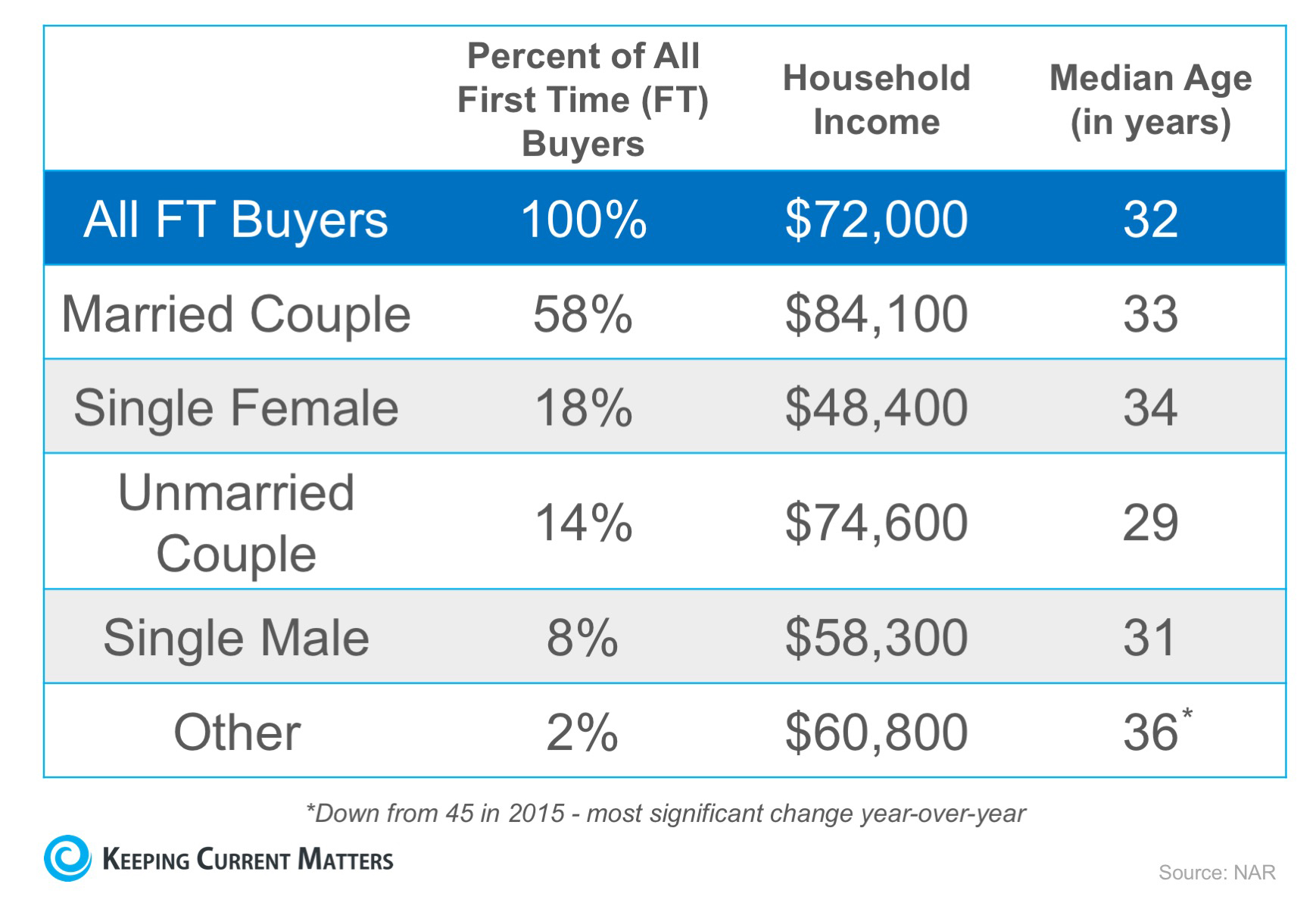
According to the National Association of REALTORS most recent Profile of Home Buyers & Sellers, married couples once again dominated the first-time homebuyer statistics in 2016 at 58% of all buyers. It is no surprise that having two incomes to save for down payments and contribute to monthly housing costs makes buying a home more attainable. But, many couples are also deciding to buy a home before spending what would be a down payment on a wedding, as unmarried couples made up 14% of all first-time buyers last year. If you’re single, don’t fret! Single women made up 18% of first-time buyers in 2016, while single men accounted for 8% of buyers. One recent article pointed to a sense of responsibility and commitment that drives many single women to want to own their home, rather than rent. Here is the breakdown of all first-time homebuyers in 2016 by percentage of all buyers, income, and age: First Comes Love… Then Comes Mortgage? | Keeping Current Matters

Bottom Line

You may not be that much different than those who have already purchased their first homes. Meet with a local real estate professional today who can help determine if your dream home is already within your grasp. 

Monday, February 6, 2017

15 vs 30 Year Fixed Rate Mortgage

The main differences between 15- and 30-year loans are straightforward. Fifteen-year loans have higher monthly payments, but you pay less interest, while 30-year terms have lower monthly payments, but you pay significantly more for the house in the long run.


Tuesday, January 31, 2017

Lower Property Taxes

The most likely case for lower property taxes is that you bought your house at a time when the economy was doing much better. At that time, you would have paid more for your home than it would be valued at now. Because of the higher price tag, you naturally paid more in taxes. Lowering your property taxes isn’t a particularly difficult process, but it is a process nonetheless. And with upfront expenses like a potential assessment of your property, it may be a case of “you need money to save money.” But if the market was more inflated at the time of your home purchase than it is now, lowering your property tax will be beneficial in the long run!


Wednesday, January 18, 2017

What is an Earnest Money Deposit? (Due Diligence)

Earnest money is a deposit made to a seller showing the buyer's good faith in a transaction. Often used in real estate transactions, earnest money allows the buyer additional time when seeking financing. Earnest money is typically held jointly by the seller and buyer in a trust or escrow account.

Monday, January 2, 2017

Save by Making An Extra Mortgage Payment


Save by making an extra mortgage payment. Divide your payment by 12 and add that amount to each monthly payment. You'll make one extra payment each year, saving you thousands of dollars and shaving four years off your mortgage.

Thursday, December 29, 2016

Start 2017 Off Right... List Your House for Sale


As we are about to bring in the New Year, families across the country will be deciding if this is the year that they will sell their current house and move into their dream home. Many will decide that it is smarter to wait until the spring "buyer's market" to list their house. In the past, that might have made sense. However, this winter is not like recent years. The recent jump in mortgage rates has forced buyers off the fence and into the market, resulting in incredibly strong demand RIGHT NOW!! At the same time, inventory levels of homes for sale have dropped dramatically as compared to this time last year. Here is a chart showing the decrease in inventory levels by category:

Bottom Line

Demand for your home is very strong right now while your competition (other homes for sale) is at a historically low level. If you are thinking of selling in 2017, now may be the time.