Showing posts with label Foreclosures. Show all posts

Tuesday, July 23, 2019

What Do I Need to Know About Mold?


There are few things that homeowners dread more than mold in the house. You’ve likely heard horror stories about people living with mold infestations that made them seriously ill. Is this just hype, or is there a real danger to having mold in your home? More importantly, what can you do if you find mold growing somewhere in the house?

What Is Mold?

Mold is a broad group of fungi, with thousands of species and subspecies around the world that typically prefer dark and damp habitats. Often fuzzy in appearance (though occasionally slimy or cottony), molds spread across materials and break them down to get the nutrients the mold needs to survive and thrive. Instead of seeds, molds release single-celled spores that in many cases are too small to see with the naked eye; these spores float through the air to land on a variety of surfaces, beginning growth once they find themselves in a suitable habitat. Though molds are made up of a number of individual stalks fibers, a connected clump of mold is considered to be a single living entity.

Types of Mold

There are several common types of mold that you might see around the house. While some of these may not be inherently dangerous, any mold can trigger reactions in anyone with an allergy or sensitivity. The five most common of these molds are:
  • Aspergillus: One of the most common indoor molds, it often appears green, blue-green or gray but can also appear white or even yellow.
  • Cladosporium: A black or green mold that has an appearance like ground pepper, it commonly grows on smooth surfaces like toilets and painted walls but can also grow in fabrics and rugs.
  • Ulocladium: A black mold that grows in wet areas, especially in cracks and corners; it is most common in homes with water damage and active leaks.
  • Aureobasidium: Varying in color from pink to brown or black, this mold most commonly grows behind wallpaper, on painted surfaces and on wood.
  • Stachybortrys: The infamous “black mold”, it features a slimy dark green or black color and thrives in areas that are damp and maintain high humidity for weeks.

Is Mold Actually Dangerous?

While many molds are allergens, most will not cause severe reactions unless you have a mold sensitivity or have other health problems that make you more prone to infection. However, some molds (such as black mold) actually are toxic and can make you very sick if you’re around them for too long. Symptoms of a mold allergy or toxic mold exposure can include a chronic cough, skin rashes, fatigue, difficulty focusing and even pain or infection in your sinuses, eyes and ears.

Mold Testing and Removal

If you suspect that you have mold problems, there are home tests available to help you identify the type of mold in your home. These should only be a first step, however, as they often aren’t enough to definitively show you the scope of your mold problem. Call in an expert to confirm the results of your test or take a scraping of the mold and have it analyzed. Be sure to wear a dust mask or other breathing protection if you aren’t sure what type of mold you’re dealing with until the problem is taken care of.

For many mold infestations, getting rid of leaks or other sources of humidity is a great way to slow or even stop mold growth. Mold can cause serious damage over time, however, so you may need professional mold removal and repair services if you can’t get the problem under control early.
Is your home in need of some serious mold removal?

Friday, August 17, 2018

The Cost of Waiting: Interest Rates Edition


Interest rates are projected to increase steadily heading into 2019. The higher your interest rate, the more money you end up paying for your home and the higher your monthly payment will be. Rates are still low right now – don’t wait until they hit 5% to start searching for your dream home!

Tuesday, April 25, 2017

For Sale By Owner vs. Realtor


For Sale By Owner vs. Realtor

When you weigh the pros and cons, you can see that you come out better when you use a professional Realtor to sell your home. timgrissett.com

Thursday, April 13, 2017

Home Mortgages: Rates Up, Requirements Easing


The media has extensively covered the rise in mortgage interest rates since last fall (from 3.42% last September to the current 4.1% according to Freddie Mac). However, a less covered aspect of the mortgage market is that requirements to get a mortgage have eased while rates have risen. The Mortgage Bankers Association (MBA) quantifies the availability of mortgage credit each month with their Mortgage Credit Availability Index (MCAI). According to the MBA, the MCAI is:
“A summary measure which indicates the availability of mortgage credit at a point in time.”
The higher the index, the easier it is to get a mortgage. Here is a chart showing the MCAI over the last several months as rates have increased. Home Mortgages: Rates Up, Requirements Easing | Keeping Current Matters

Have requirements for attaining a mortgage actually eased?

Yes. Here are two examples:
  1. FICO® Score – the credit score which helps determine a buyer’s eligibility. The score required to attain a mortgage has been falling over the last five months:
Home Mortgages: Rates Up, Requirements Easing | Keeping Current Matters
  1. Down Payment Requirement – the percentage of the purchase price necessary to place as a down payment on a home. To make this point, let’s look at the percentage of first-time buyers who have put less than 5% down over the last several years as compared to the 1st quarter of 2017:
Home Mortgages: Rates Up, Requirements Easing | Keeping Current Matters

Bottom Line

Whether you are a current homeowner looking to move to a home that will better serve your family’s current needs, or a first-time buyer looking for a starter home, it is easier to get a mortgage today than it has been at any other time in the last ten years.

Wednesday, April 5, 2017

Buying this Spring? Be Prepared for Bidding Wars


Traditionally, spring is the busiest season for real estate. Buyers come out in force and homeowners list their houses for sale hoping to capitalize on buyer activity. This year will be no different! Buyers have already been out in force looking for their dream homes and more are on their way, but the challenge is that the inventory of homes for sale has not kept up with demand, which has lead to A LOT of competition for the homes that are available. A recent Bloomberg article touched on the current market conditions:
“It’s the 2017 U.S. spring home-selling season, and listings are scarcer than they’ve ever been. Bidding wars common in perennially hot markets like the San Francisco Bay area, Denver and Boston are now also prevalent in the once slow-and-steady heartland, sending prices higher and sparking desperation among buyers across the country.”
Sam Khater, Deputy Chief Economist at CoreLogic went on to explain why buyers are flocking to the market in big numbers:
“In today’s market, many buyers think the trough in [interest] rates is over. If you don’t get in now, it’s just going to be worse later. Rates will be higher, prices will be higher, and maybe inventory selection will be lower.”
In some markets, “thirty-five percent of properties are selling within the first week or two of hitting the market.” Homes are selling at a rapid clip in places like:
  • Denver, CO
  • Seattle, WA
  • Oakland, CA
  • Grand Rapids, MI
  • Boise, ID
  • Madison, WI
  • Omaha, NE

Bottom Line

In today’s competitive atmosphere, you need a professional on your side who knows your exact market conditions and can help you take the steps you need to be able to secure your new home!

Wednesday, February 22, 2017

Tuesday, January 31, 2017

Lower Property Taxes

The most likely case for lower property taxes is that you bought your house at a time when the economy was doing much better. At that time, you would have paid more for your home than it would be valued at now. Because of the higher price tag, you naturally paid more in taxes. Lowering your property taxes isn’t a particularly difficult process, but it is a process nonetheless. And with upfront expenses like a potential assessment of your property, it may be a case of “you need money to save money.” But if the market was more inflated at the time of your home purchase than it is now, lowering your property tax will be beneficial in the long run!


Friday, November 25, 2016

What You Need to Know About the Mortgage Process [INFOGRAPHIC]


Some Highlights:

  • According to Freddie Mac, 40% of buyers are putting less than 10% down, with many putting down as little as 3%.
  • Have a budget and stick to it!
  • Know your credit score and history!
  • Reach out to a professional who can help you with the process!

Monday, October 31, 2016

Taking the Fear out of the Mortgage Process


A considerable number of potential buyers shy away from jumping into the real estate market due to their uncertainty about the buying process. A specific cause for concern tends to be mortgage qualification.

For many, the mortgage process can be scary, but it doesn't have to be!

In order to qualify in today's market, you'll need to have saved for a down payment (the average down payment on all loans was 11% last month, with many buyers putting down 3% or less), a stable income and good credit history. Throughout the entire home buying process, you will interact with many different professionals, all of which perform necessary roles. These professionals are also valuable resources for you. Once you're ready to apply, here are 5 easy steps that Freddie Mac suggests to follow:
  1. Find out your current credit history & score - even if you don't have perfect credit, you may already qualify for a loan. The average FICO Score of all closed loans in September was 731, according to Ellie Mae.
  2. Start gathering all of your documentation - income verification (such as W-2 forms or tax returns), credit history, and assets (such as bank statements to verify your savings).
  3. Contact a professional - your real estate agent will be able to recommend a loan officer that can help you develop a spending plan, as well as determine how much home you can afford.
  4. Consult with your lender - he or she will review your income, expenses, and financial goals in order to determine the type and amount of mortgage you qualify for.
  5. Talk to your lender about pre-approval - a pre-approval letter provides an estimate of what you might be able to borrow (provided your financial status doesn't change), and demonstrates to home sellers that you are serious about buying!

Bottom Line

Do your research, reach out to professionals, stick to your budget, and be sure that you are ready to take on the financial responsibilities of becoming a homeowner.

Friday, October 28, 2016

Buying a Home Can Be Scary... Know the Facts

Some Highlights: 36% of Americans think they need a 20% down payment to buy a home. 44% of Millennials who purchased a home this year have put down less than 10%. 8% of loan applications were approved last month. The average credit score of approved loans was 731 in September.


Wednesday, October 26, 2016

Tuesday, October 25, 2016

Buying is Now 37.7% Cheaper Than Renting in the US


The results of the latest Rent vs. Buy Report from Trulia show that homeownership remains cheaper than renting with a traditional 30-year fixed rate mortgage in the 100 largest metro areas in the United States. The updated numbers actually show that the range is an average of 17.4% less expensive in Honolulu (HI), all the way up to 53.2% less expensive in Miami & West Palm Beach (FL), and 37.7% nationwide!

Other interesting findings in the report include:

  • Interest rates have remained low, and even though home prices have appreciated around the country, they haven't greatly outpaced rental appreciation.
  • Home prices would have to appreciate by a range of over 23% in Honolulu (HI), up to over 45% in Ventura County (CA), to reach the tipping point of renting being less expensive than buying.
  • Nationally, rates would have to reach 9.1%, a 145% increase over today's average of 3.7%, for renting to be cheaper than buying. Rates haven't been that high since January of 1995, according to Freddie Mac.

Bottom Line

Buying a home makes sense socially and financially. If you are one of the many renters out there who would like to evaluate your ability to buy this year, let's get together to help you find your dream home.

Dear Investors: Highly Recommended Reading


Demystify the process of evaluating, acquiring, and managing rental property and becoming a landlord with "Buy It, Rent It, Profit!: Make Money As a Landlord in Any Real Estate Market"


Monday, October 24, 2016

Sales of Distressed Properties Hit New Low


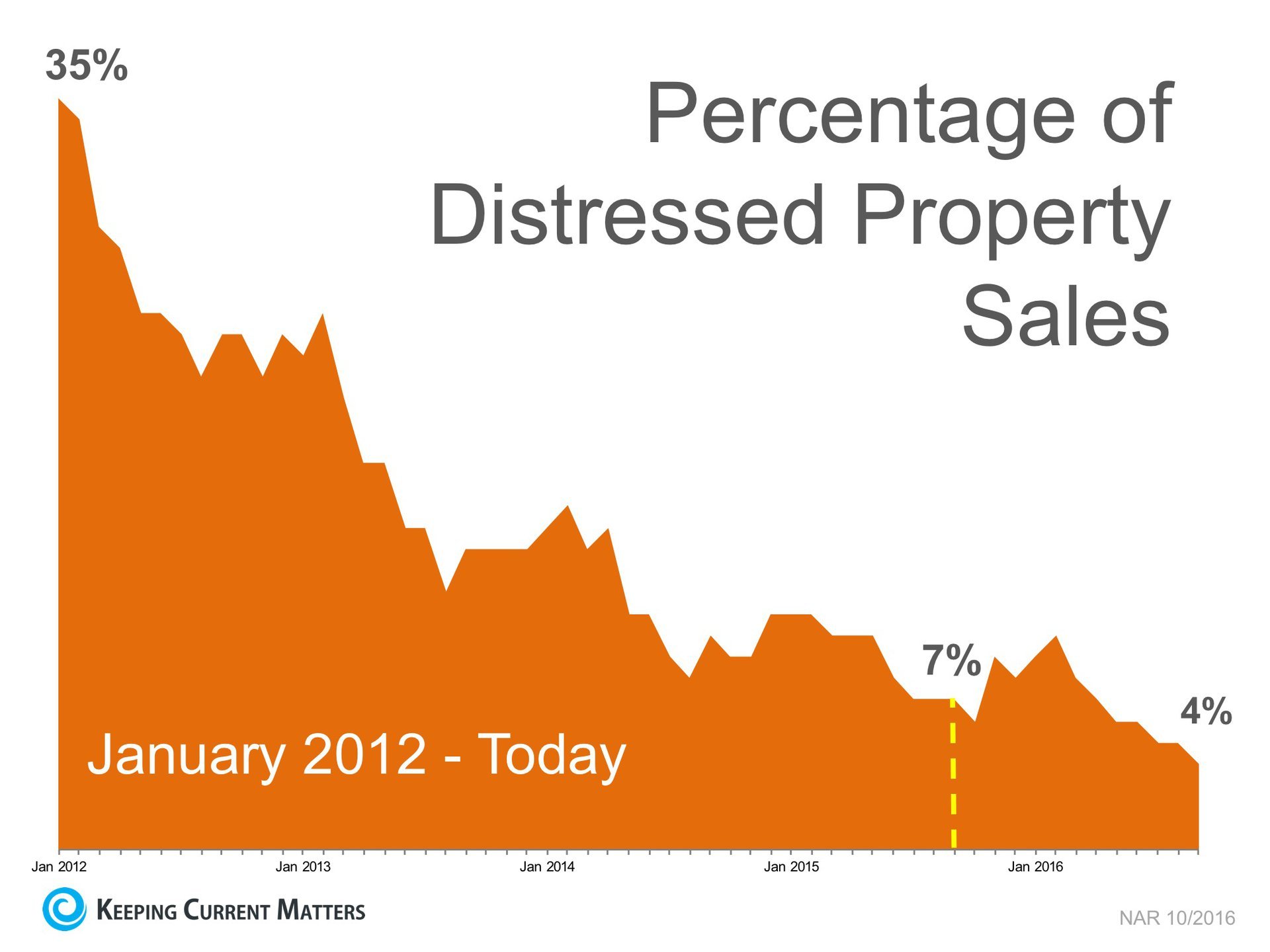
The National Association of Realtors (NAR) recently released their latest Existing Home Sales Report revealing that distressed property sales accounted for 4% of sales in September. This is down from 7% in 2015, and is the lowest figure since NAR began tracking distressed sales in October 2008. Below is a graph that shows just how far the market has come since January 2012 when distressed sales accounted for 35% of all sales. Sales of Distressed Properties Hit New Low | Keeping Current Matters

Existing Home Sales Hit 2nd Highest Figure Since June

Mortgage interest rates remained well below 4% in September at 3.46%, prompting existing home sales to stay at a healthy annual pace of 5.47 million. Month-over-month sales were up 3.2%. Inventory of homes for sale remains below the 6-month supply that is necessary for a normal market, as it fell 2.2% to a 4.5-month supply. The shortage in inventory has contributed to the median home price rising an additional 5.6% to $234,200. NAR's Chief Economist, Lawrence Yun had this to say about the lack of inventory:
"Inventory has been extremely tight all year and is unlikely to improve now that the seasonal decline in listings is about to kick in."
There is good news though, as Yun went on to say:
"There's hope the leap in sales to first-time buyers can stick through the rest of the year and into next spring. The market fundamentals -- primarily consistent job gains and affordable mortgage rates -- are there for the steady rise in first-timers needed to finally reverse the decline in the homeownership rate."

Bottom Line

If you are debating putting your home on the market this year, now may be the time. Buyers are still out there looking for their dream home. Meet with a local real estate professional who can help you determine your best plan.