Showing posts with label Tax Benefits. Show all posts

Friday, December 20, 2019

Bargain Buying 101: Things to Look for In a Deal


When you’re shopping for a new home, it’s not uncommon to face a little bit of sticker shock when it comes to price. This often leads to buyers trying to find a good balance between what they want and what they can afford. However, if you’re smart (and maybe a little lucky), you may be able to find some really great deals if you know what to look for.

One of the keys to finding a good deal is to look for properties that have qualities that might seem unappealing at first but that can be corrected fairly easily. Some of these things can drive prices down significantly but won’t require a major renovation to fix. If you’re hoping to find a bargain, here are a few things to look out for.

Ugly Paint

Even though there’s a lot of damage that can make your paint look ugly, sometimes the paint is just ugly because someone chose to bring together colors that should never coexist. It could be awful colors, it could be cheap paint that’s faded over time or it could even be an amateur paint job that never got touched up. Regardless of the reason for the ugly paint job, it can drive the price of the property down by thousands or even tens of thousands of dollars. It doesn’t even have to be the entire house; one ugly room can give you an opportunity to find a good deal on an otherwise nice property.

Landscaping Issues

A property’s yard is one of the first things that potential buyers see. If it’s obviously been neglected or has bald patches and overgrown flower beds, this can make a negative first impression because it suggests that the house itself might not have been taken care of either. That isn’t always the case, though. Even if the house is in good condition, a yard that needs some TLC can usually shave some money off the asking price and help you to net a great deal.

Fixtures and Accents

There are a lot of cosmetic elements in houses that can start looking rough over time. Handles and knobs can come loose or become tarnished, shutters can get loose, bathroom tiles can become cracked… the list goes on. While updating these issues won’t break the bank, many sellers will drop their asking price quite a bit due to how these little things make the house look.

Bathroom Concerns

A lot of buyers shy away from houses that have obvious bathroom problems, causing those sellers to bring the price down significantly in many cases. Depending on the extent of the issues in the bathroom, though, there could be a real opportunity here. If the problem with the bathroom is mostly cosmetic, then you may be able to fix it on the relatively cheap side and save a lot of money in the process. Just be sure to keep an eye out for signs of water damage or mold, since that could indicate problems that would be much more expensive to fix.

Previous Foreclosure

One other strategy for finding a deal is to look for bank-owned properties that were previous foreclosures. These properties are often sold at a discount because the bank isn’t necessarily trying to sell the house at market value, it’s simply trying to recoup the money it lost when it had to foreclose. The amount you can save will depend on both the bank and the amount of equity that was in the home when it was foreclosed, but you may luck into a great deal on a nice house this way. Just be aware that while there are legitimate programs that can help you find a foreclosed property, there are also some scammy ones out there as well.

Call in the Experts

Having your Realtor help you with your search is another way to find hidden gems and get a bargain on your next home. They can find you properties that need some of these little fixes and give you an idea of what sort of updates the property could need.

Thursday, July 18, 2019

The Surprising Profile of the Real Estate Investor


Over 10% of all residential homes are purchased by investors, and that number continues to rise. Who are these investors?

Many have speculated that the large institutional conglomerates such as Blackstone, American Homes 4 Rent, and Colony Starwood dominate investor purchases. However, a special report on investor home buying by CoreLogic, Don’t Call it a Comeback: Housing Investors Have Been Here for Years, shows this is not the case.

Ralph McLaughlin, CoreLogic’s Deputy Chief Economist and author of the report, explained his findings at the recent National Association of Real Estate Editors conference in Austin:
“Investor buying activity in the U.S. is at record highs. And our records go back confidently, about 20 years…
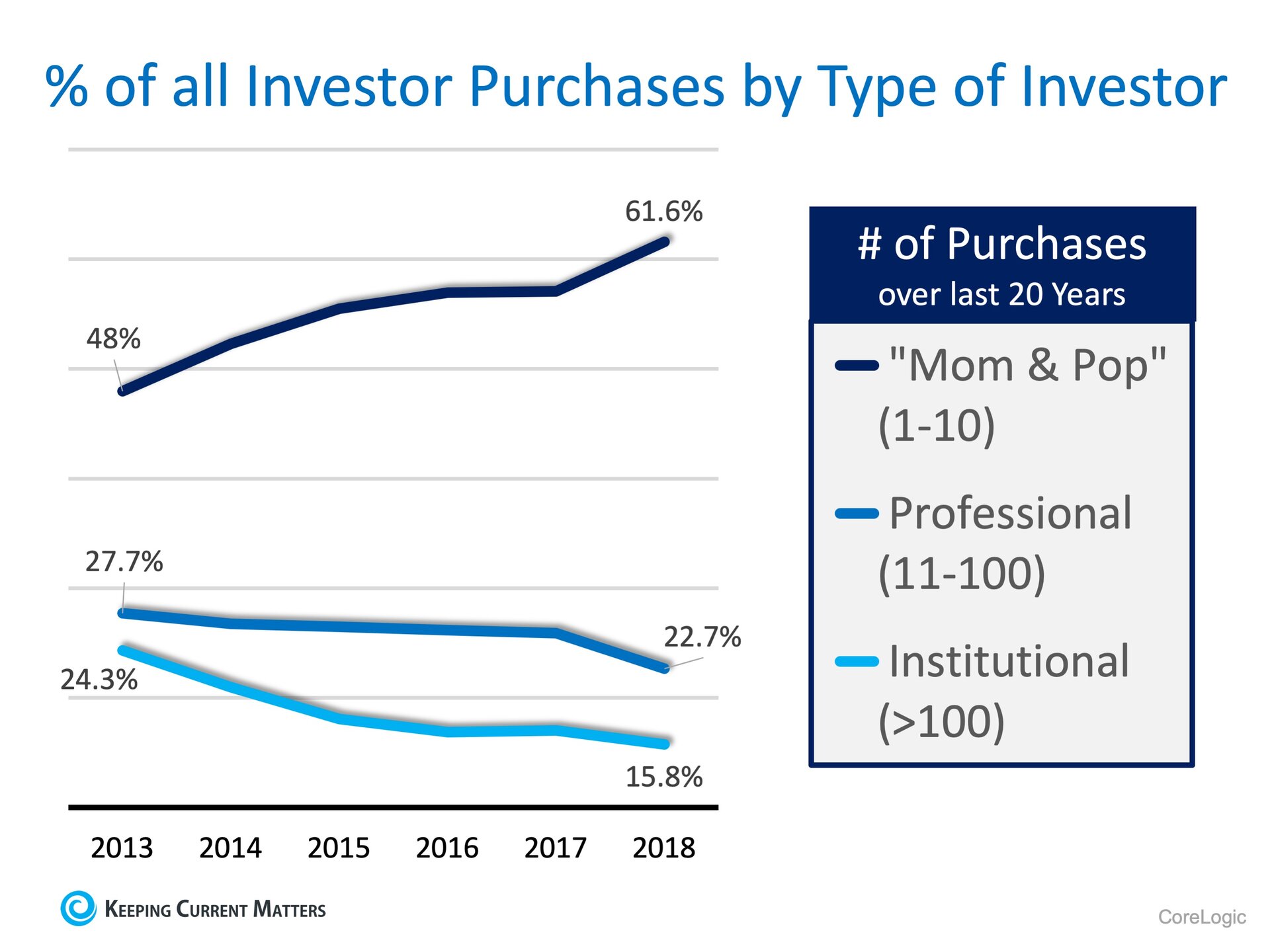
What’s going on and why? Well, it turns out, it’s not the big institutional guys that are leading the increase in home buying. It’s actually the smaller guys. It’s those that have bought between one and ten properties over this 20-year period, they’re the ones that are really leading the increase in investor home buying.”
Here is the breakdown of the percentage of purchasers by type of investor over the last six years according to the report:The Surprising Profile of the Real Estate Investor | Keeping Current MattersAs the graph shows, the percentage of “Mom & Pop” investors is currently dominating the number of homes purchased by investors, as the percentage of homes purchased by both professional and institutional investors is falling.

Bottom Line

Most houses purchased by an investor are bought by small investors looking to diversify their financial portfolio by adding a real estate component. If you are investing in real estate as either a landlord or someone who fixes-up and flips the house, speak to a local real estate professional. They can help you build or liquidate your current portfolio of properties.

Wednesday, June 26, 2019

Before You Look for Your Dream Home: Know What You Want vs. What You Need!


In this day and age of being able to shop for anything anywhere, it is really important to know what you’re looking for when you start your home search.


If you’ve been thinking about buying a home of your own for some time now, you’ve probably come up with a list of things that you’d LOVE to have in your new home. Many new homebuyers fantasize about the amenities that they see on television or Pinterest, and start looking at the countless homes listed for sale through rose-colored glasses.


Do you really need that farmhouse sink in the kitchen to be happy with your home choice? Would a two-car garage be a convenience or a necessity? Could the “man cave” of your dreams be a future renovation project instead of a make-or-break right now?
The first step in your home buying process should be getting pre-approved for your mortgage. This allows you to know your budget before you fall in love with a home that is way outside of it.

The next step is to list all the features of a home that you would like, and to qualify them as follows:
  • “Must-Haves” – if this property does not have these items, then it shouldn’t even be considered (ex: distance from work or family, number of bedrooms/bathrooms).
  • “Should-Haves” – if the property hits all of the ‘must-haves’ and some of the ‘should-haves,’ it stays in contention but does not need to have all of these features.
  • “Absolute-Wish List” – if we find a property in our budget that has all of the ‘must-haves,’ most of the ‘should-haves,’ and ANY of these, it’s the winner!

Bottom Line

Having this list fleshed out before starting your search will save you time and frustration. It also lets your agent know what features are most important to you before they start showing you houses in your desired area.

Friday, March 24, 2017

Why a Good Home Appraisal is Important

A good home appraisal is one of the most important components of getting approved for a mortgage. This appraisal ultimately decides just how much a bank is willing to lend to you, and a bad appraisal can kill your plans for a new home faster than a bad credit score. A home appraisal is the best way for a lender to see if they wont lose their seat on the deal.


The lender wants to make sure that they have an asset that they can sell to get their money back in case of default. The home appraisal is also a way for you to see if the home you are wanting is overpriced or not.

Lets say that John Doe wants to secure a mortgage on a home that cost $180,000. His credit score is very good, yet the home only appraises for $150,000.

Will John get his loan? You better believe he won't. The sale price will have to be lowered for the lender to consider to loan John the money. This is also a warning for John, that the home that he is trying to secure may be overpriced.

So what does an appraiser look for?
An appraisal usually starts with an inspection of the inside and outside of your home, as well as sale and ask prices for comparable homes in the area.The appraiser will create a report for the lender that includes:
  • An explanation of how the appraiser determined the value of the property
  • The size and condition of the house and other permanent fixtures, along with a description of any improvements that have been made and the materials used
  • Statements regarding serious structural problems, such as wet basements and cracked foundations
  • Notes about the surrounding area, such as new or established development, rural acreage, and so on
  • Evaluation of recent market trends of the area that may affect the value
  • Comparative market analysis that supports the appraisal: maps, photographs and sketches

An important thing to note is that, an appraiser is not a home inspector. An appraiser will make note of obvious issues but does not inspect the home to see if it is up to code. For this you will actually need to hire someone to do a home inspection to avoid any costly nightmares in the future if something is wrong with the house.

How much is this going to cost me?
Appraisals typically cost in the range of $300- $400. This price can change though depending on the location of the property, square footage of the home, or property type. The appraiser’s fees are usually included in the closing costs of the home, unless a deal on the property is not made.

Is it time to throw in the towel if the appraisal is too low?

First you need to see why the appraisal was low. It could be something that the homeowner could correct, or the home could be overpriced. If it is overpriced see if the homeowner would come down on their price. You can also request another appraisal on the home, keep in mind that you are the one paying for these appraisals.

As a seller what can you do to make up for a bad appraisal?

The first thing you need to do is see why it was appraised lower, it could be because of maintenance or repairs. If this is the case, you can get another appraisal after they have been fixed. Another way to increase the appraisal price is cosmetics, especially in an older home. New paint, appliances, carpet and replacement windows are all ways to add to the value of your home.

Thursday, March 2, 2017

Lower Property Taxes

The most likely case for lower property taxes is that you bought your house at a time when the economy was doing much better. At that time, you would have paid more for your home than it would be valued at now. Because of the higher price tag, you naturally paid more in taxes. Lowering your property taxes isn’t a particularly difficult process, but it is a process nonetheless. And with upfront expenses like a potential assessment of your property, it may be a case of “you need money to save money.” But if you the market was more inflated at the time of your home purchase than it is now, lowering your property tax will be beneficial in the long run! #PropertyTax

Thursday, February 23, 2017

Retire Without Rent

If you want to retire without rent, you need to start planning your mortgage now. We’ve compiled some stats about retirement age incomes and developed a formula to ensure anybody can go into their golden years with equity under their belt and bills off their minds.

Retirement age is 65. The average social security payout per month is $1,180.80. The average 401k at the time of retirement is just north of $100,000 as of 2015, meaning there’s a monthly payout of roughly $270.77. Unfortunately the average mortgage payment int he U.S. is $1,061. That’s almost the entirety of an retiree’s expected $1,451.57 monthly income.
The average age for a first time home buyer is 31, and the average income is $61,800. So if you buy a house at 31 and get a 30 year fixed rate mortgage, that still leaves you 4 years for unforeseen circumstances and major upgrades. Then you can retire at 65 with equity and no debts!

Wednesday, February 22, 2017

Friday, February 3, 2017

Get Ready to Buy A House

Still a ways away from buying, but want to be responsible? No matter your timeline, these tips will help every aspiring homeowner get ready…

Monday, January 30, 2017

Possible Tax Benefits for Homeowners


While everyone’s situation is different, many homeowners find that they’re able to reap the benefits of homeownership, which often include:

Mortgage interest. For most people, the majority of a monthly mortgage payment goes toward paying off interest. Often, that interest is deductible (unless your loan is over $1 million, in which case the amount you can deduct is limited).

Points. If you paid points to get a better rate on a mortgage, you could claim them on your tax return as a deduction. However, it’s a good idea to talk to a tax expert about when you can claim your points.


Property taxes. Because some of your monthly loan payment likely goes toward property taxes, where it sits in escrow until they’re due, you can typically deduct them each year for as long as you own the home.


Profits. If you’ve made a profit on the sale of one home as you moved into another, you might be able to deduct some of the profits you made. However, these instances are limited to meeting certain requirements or if you’ve sold under certain circumstances.