Showing posts with label Real Estate Investing. Show all posts

Tuesday, January 7, 2020

3 Benefits to Buying Your Dream Home This Year


Outside of a strong economy, low unemployment, and higher wages, there are three more great reasons why you may want to consider buying your dream home this year instead of waiting.

1. Buying a Home is a Great Investment

Several reports indicate that real estate is a good investment, topping other options such as gold, stocks, bonds, and savings. Why? Real estate helps build equity, a form of investing for you and your family. According to CoreLogic’s Equity Report,
“U.S. homeowners with mortgages (roughly 64% of all properties) have seen their equity increase by a total of nearly $457 billion since the third quarter 2018, an increase of 5.1%, year over year.”
This means the average homeowner gained approximately $5,300 in equity over the past year. If you want to start building your equity, put your housing costs to work for you through homeownership this year.

2. Mortgage Interest Rates Are Low

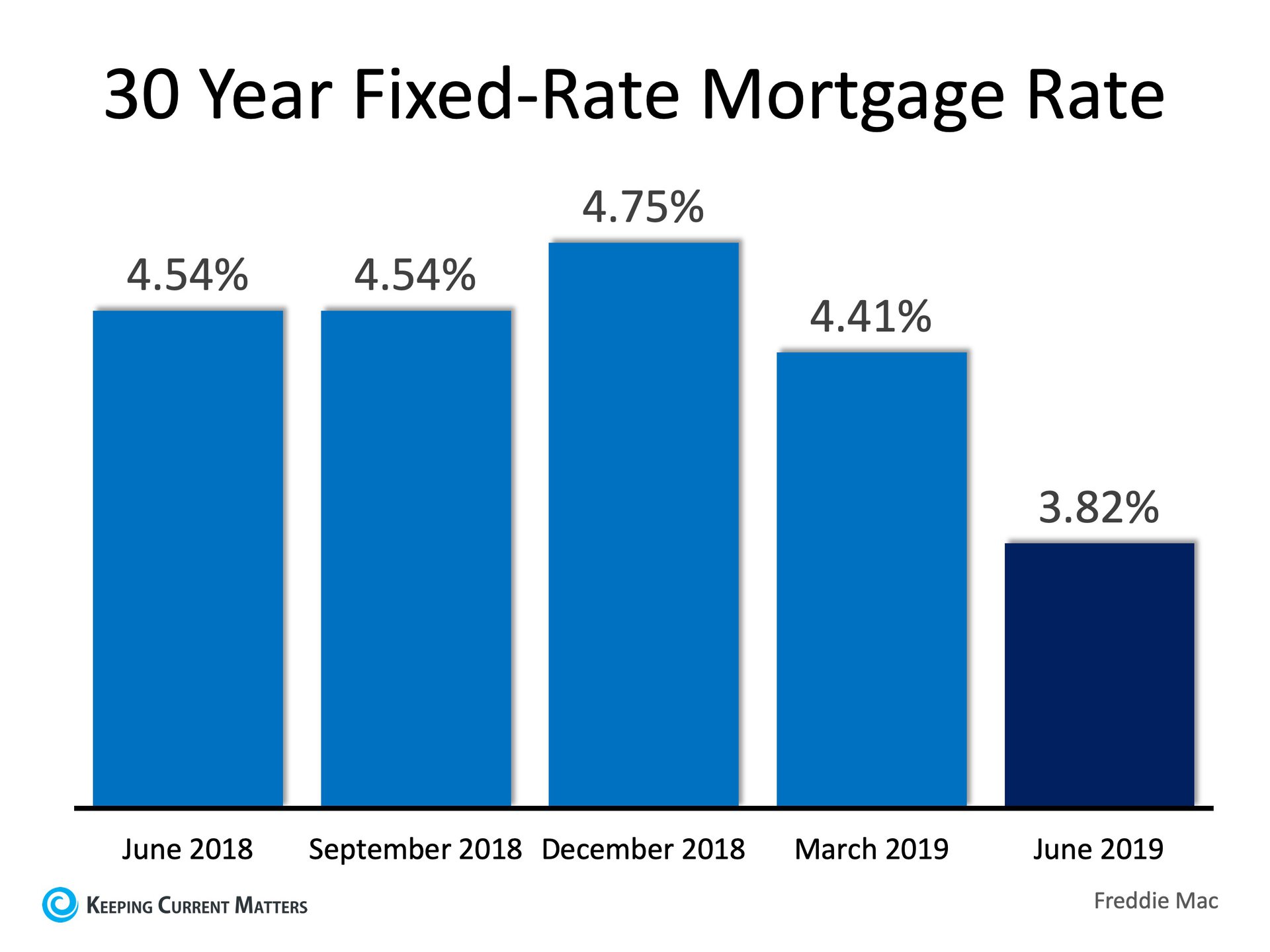
The Primary Mortgage Market Survey from Freddie Mac indicates that interest rates for a 30-year mortgage have fallen since November 2018 when they hit 4.94%. In their latest forecast, Freddie Mac expects rates to remain low, leveling out to a yearly average of 3.8% in 2020.
When you purchase a home at a low mortgage rate, it will impact your monthly mortgage payment, giving you the opportunity to buy more house for your money.

3. Investing in Your Family is a Win

There are some renters who haven’t purchased a home yet because they’re uncomfortable taking on the obligation of a mortgage. Everyone should realize that, unless you’re living rent-free with your parents, you’re paying a mortgage – either yours or that of your landlord.
Today, rental prices continue to increase, and when you’re paying your landlord’s mortgage instead of your own, you’re not the one earning the equity. As an owner, your mortgage payment is a form of ‘forced savings’ you can use later in life to reinvest in your family. You can use it for a variety of opportunities, such as saving for your children’s education, moving up to a bigger home, or starting your own business. As a renter, it can be more challenging to achieve those types of dreams without home equity working for you.

Bottom Line

Buying a home sooner rather than later could lead to substantial savings and long-term financial growth for you and your family. Reach out to a local real estate professional to determine if homeownership is the right choice for you this year.

Tuesday, December 17, 2019

Is It Risky to Buy a New Home Before Selling My Current One?

Which comes first, the chicken (buying a new home) or the egg (selling your current home)? There is no simple answer. Knowing and understanding your options can help you make the decision that’s right for you. There can be several advantages to buying a new home before selling your current one, so we've broken down a few things you should consider.

Timing Your Move

You can take your time with the buying and moving process. You’ll have more time to shop for a new home that has the features and location that you want. Then once you buy your new home you can move in at your own pace, and put your current home on the market when ready. 

On the other hand, if you sell your current home before buying, you face the possibility of not having a place to live. There are options. You could rent until you buy a new home, including the possibility of renting your current home from the new owners. Or, once you have an offer, you can begin shopping for your new home and try to coordinate closing dates. While not impossible, this would take a bit of finagling and a lot of luck.

Financing Your Move

If you still owe money on your current home, then you’ll have to be able to afford two mortgages until your current home sells. How quickly that happens depends on the housing market in your area. Having two house payments will limit your purchasing power for a new home.

Selling before you buy gives you the advantage of knowing the exact amount you can put toward your new home purchase. While this might give you more peace of mind and buying power, it might mean missing out on homes you want while waiting for yours to sell.

Ask the Professionals

Your real estate agent can estimate the value of your current home and how quickly the current market is moving. They can also help you find information about neighborhoods you are interested in moving to and how much buying power you’ll need for the home you want.

A mortgage lender can help you figure out if you can afford to have two mortgages. They can also inform you about how to use equity in your current home to help with the down payment on a new home.

Whether you decide to buy first or sell first, you can make the process easier by being prepared and able to take action when the right opportunity comes along.

Have more questions about buying a new home before selling your current one? Feel free to contact me for more information.

Friday, December 13, 2019

VA Loan Limits Removed


Veterans are no longer restricted to a loan limit beginning January 1, 2020.  Previously, veterans were limited by the same restrictions set by the Federal Housing Finance Agency on conforming loans.  While these limits were national in nature, there were exceptions for high-cost counties and jumbo loan procedures.

The elimination of loan limits doesn't mean that veterans will have unlimited borrowing power.  Buyers must still qualify with enough income and credit requirements to meet the lender's requirements to qualify for the loan.

Lenders can set their own in-house maximum loan amounts which means it could vary from lender to lender.  Veterans who have an active VA loan or have defaulted on a previous VA loan are still limited by the previous loan limits.

The VA funding fee is increasing on January 1, 2020 to 2.3% of the loan amount for "first-use" borrowers from the previous fee of 2.15%.  Subsequent use borrowers will pay 3.6% of the loan amount instead of the current 3.3%.

Beginning in 2020, the funding fees will be the same for regular military, National Guard and reservists.  At the same time, Purple Heart recipients are exempt from paying the VA funding fee.
It is recommended that a veteran, as well as any buyer, be pre-approved before beginning the home buying process.  Veterans can find answers to specific questions they may have from a qualified and trusted loan professional.

Monday, October 21, 2019

5 Tips for Starting Your Home Search


In today’s market, low inventory dominates the conversation in many areas of the country. It can often be frustrating to be a first-time homebuyer if you aren’t prepared. Here are five tips from realtor.com’s article, “How to Find Your Dream Home—Without Losing Your Mind.”
1. Get Pre-Approved for a Mortgage Before You Start Your Search
One way to show you’re serious about buying your dream home is to get pre-qualified or pre-approved for a mortgage. Even if you’re in a market that is not as competitive, understanding your budget will give you the confidence of knowing whether or not your dream home is within your reach. This will help you avoid the disappointment of falling in love with a home well outside your price range.
2. Know the Difference Between Your ‘Must-Haves’ and ‘Would-Like-To-Haves’
Do you really need that farmhouse sink in the kitchen to be happy with your home choice? Would a two-car garage be a convenience or a necessity? Before you start your search, list all the features of a home you would like. Qualify them as ‘must-haves’, ‘should-haves’, or ‘absolute-wish list’ items. This will help you stay focused on what’s most important.
3. Research and Choose a Neighborhood Where You Want to Live
Every neighborhood has unique charm. Before you commit to a home based solely on the house itself, take a test-drive of the area. Make sure it meets your needs for “amenities, commute, school district, etc. and then spend a weekend exploring before you commit.”
4. Pick a House Style You Love and Stick to It
Evaluate your family’s needs and settle on a style of home that will best serve those needs. Just because you’ve narrowed your search to a zip code doesn’t mean you need to tour every listing in that vicinity. An example from the article says, “if you have several younger kids and don’t want your bedroom on a different level, steer clear of Cape Cod–style homes, which typically feature two or more bedrooms on the upper level and the master on the main.”
5. Document Your Home Visits
Once you start touring homes, the features of each individual home will start to blur together. The article suggests keeping your camera handy and making notes on the listing sheet to document what you love and don’t love about each property you visit.

Bottom Line

In a high-paced, competitive environment, any advantage you can give yourself will help you on your path to buying your dream home.

Thursday, August 29, 2019

iBuyers: What Is the “Cost of Convenience” When Selling Your Home?


When thinking about selling their house, homeowners have many options. A relatively new option is using an “iBuyer.” What is an iBuyer?

According to Jovio, the definition is:
“A company or investor that uses Automated Valuation Models (AVMs) to make instant offers on homes. It allows sellers to close on a property quickly. Once sold, the company then turns around and resells the home for a profit.”
Today, there are many iBuyer companies such as OfferPad, Zillow Offers, Knock, Opendoor, and Perch. Even some more traditional companies offer the same or similar services (ex. Keller Williams, Redfin, Realogy). Ivy Zelman reported in her ‘Z’ Report that some traditional brokers are partnering with some of the larger iBuyers too:
“Keller Williams announced a partnership with Offerpad, aligning the largest franchise-based brokerage brand in the U.S. with the five-year-old iBuyer. The move follows Realogy’s partnership with Home Partners of America last year as an established brokerage player more directly providing an iBuyer alternative…
Likewise, in early July, Redfin and Opendoor announced a partnership, starting in Phoenix and Atlanta – aligning interests of the 13-year old, tech-enabled and value-focused brokerage with the largest and longest-standing iBuyer. Outside of these larger scale alliances, Zillow’s strategy has been to work with local brokerages as partners on a market-by-market basis.”

Does it make sense to sell your home to an iBuyer?

It depends. Collateral Analytics recently released a study which revealed the advantages and disadvantages of using an iBuyer. According to the study, if the homeowner is looking for the convenience of a quick sale with less uncertainty, using an iBuyer may make sense.
“iBuyers offer quicker closings for sellers who would like to avoid the uncertainty of knowing when and if their home will sell. For motivated sellers who want a predictable sale date and need to move, perhaps a long distance from the current location, there is no question that iBuyers have provided a welcome alternative to traditional brokerage.”
The study, however, also showed there is a cost for that convenience. Collateral Analytics explained:
“Traditional brokers fees generally range from 5% to 7% of the sales price…In addition to this cost, buyers typically pay some closing costs including lender related charges in the range of 1% to 3%.”
In contrast:
“iBuyers charge sellers a ‘convenience fee’ of 6% to 9.5%, some also charge the seller for fees typically paid by buyers at closing adding another 1% or more. Most iBuyers will inspect the home, assess a generous home repair allowance and negotiate a (an additional) credit to handle such repairs…Overall the total direct costs, ignoring repair credits, will run 7% to 10% for an iBuyer, versus the typical 5% to 9% combined seller and buyer costs with a traditional broker. Yet, that is not the end of the story or comparison.”
The study went on to explain how iBuyers need to charge even more because they have additional expenses beyond that of the traditional broker. They include:
  1. Carrying costs involving significant amounts of capital – The iBuyer must pay the expenses of the house between the time they purchase it and the time they sell it to a new buyer.
  2. Safeguarding the home risks – A home with an iBuyer ‘For Sale Sign’ alerts anyone passing that the house is vacant. The study suggests that these homes could become targets for vagrants and criminals.
  3. Adverse selection risks – The study explains that since iBuyers use computer models to determine their offer, they may be unaware of certain challenges in the neighborhood that could adversely impact the value.
  4. Potential home price declines – As the survey states:
“A downturn in home prices, not forecast by the iBuyer market analysts could be devastating as they ramp up their business platforms, particularly if the cost of capital increases. At the same time, downturns are precisely when the most sellers would want this option.”

Bottom Line

After taking a thorough look at the iBuyer platform, the study concludes that using an iBuyer is more expensive for the homeowner than the traditional brokerage model, but for some sellers, it may still make sense:
“These preliminary empirical results suggest that sellers are paying not just the difference in fees of 2% to 5% more than with traditional agencies, and a generous repair allowance, but another 3% to 5% or more to compensate the iBuyer for liquidity risks and carrying costs. In all, the typical cost to a seller appears to be in the range of 13% to 15% depending on the iBuyer vendor. For some sellers, needing to move or requiring quick extraction of equity, this is certainly worthwhile, but what percentage of the market will want this service remains to be seen.”

Monday, August 19, 2019

A Great Way to Increase Your Family’s Net Worth


Every three years, the Federal Reserve conducts its Survey of Consumer Finances. Data is collected across all economic and social groups. The latest survey data covers 2013-2016.

The study revealed that the median net worth of a homeowner is $231,400 – a 15% increase since 2013. At the same time, the median net worth of renters decreased by 5% ($5,200 today compared to $5,500 in 2013).

These numbers reveal that the net worth of a homeowner is over 44 times greater than that of a renter.

Owning a home is a great way to build family wealth.

As we’ve said before, simply put, homeownership is a form of ‘forced savings.’ Every time you pay your mortgage, you are contributing to your net worth by increasing the equity in your home.
That is why Gallup reported Americans picked real estate as the best long-term investment for the sixth year in a row. According to this year’s results, 35% of Americans chose real estate. Stocks followed at 27%, then savings accounts and gold.

Bottom Line

If you want to find out how you can use your monthly housing cost to increase your family’s wealth, meet with a real estate professional in your area who can guide you through the process.

Thursday, August 1, 2019

How to Judge the Impact of the Next Economic Slowdown on Housing


We’ve experienced economic growth for almost a decade, which is the longest recovery in the nation’s history. Experts know a recession can’t be too far off, but when will this economic slowdown actually occur?

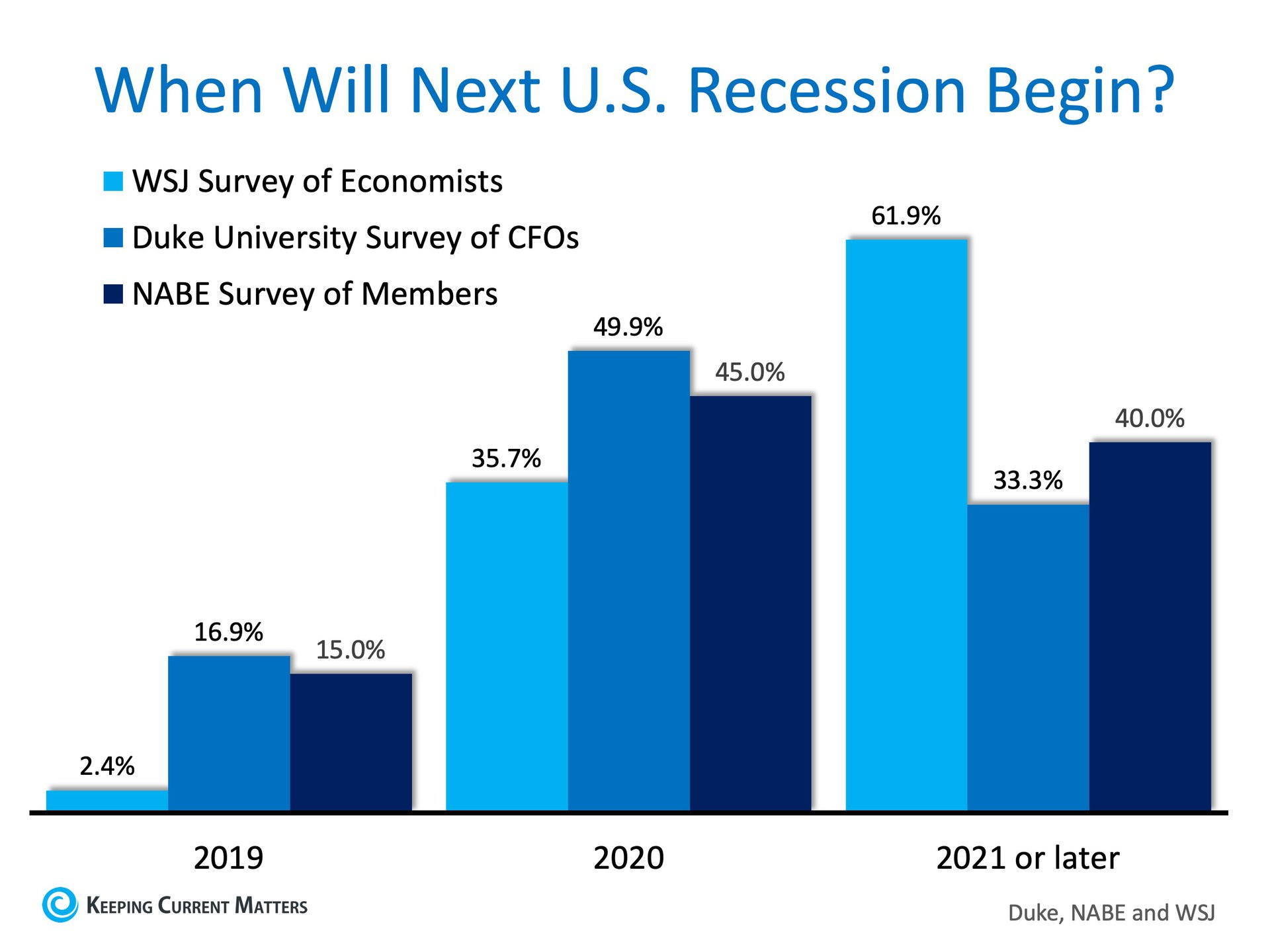
Pulsenomics just released a special report revealing that nearly 6 out of 10 of the 90 economists, investment strategists, and market analysts surveyed believe the next recession will occur by the end of next year. Here’s the breakdown:
  • 9% believe a recession will occur this year
  • 50% believe it will occur in 2020
  • 35% believe it will occur in 2021
  • 6% believe it will occur after 2021
When asked what would trigger the next recession, the three most common responses by those surveyed were:
  1. Trade Policy
  2. Stock Market Correction
  3. Geopolitical Crisis

How might the recession impact real estate?

Challenges in the housing and mortgage markets were major triggers of the last recession. However, a housing slowdown ranked #9 on the list of potential triggers for the next recession, behind such possibilities as fiscal policy and political gridlock.

As far as the impact the recession may have on home values, the experts surveyed indicated home prices would continue to appreciate over the next few years. They called for a 4.1% appreciation rate this year, 2.8% in 2020, and 2.5% in 2021.

Bottom Line

On the same day, in the same survey, the same experts who forecasted a recession happening within the next 18 months also claimed housing will not be the trigger, and home values will still continue to appreciate.

Tuesday, July 30, 2019

How to Increase Your Equity Over the Next 5 Years


Many of the questions currently surrounding the real estate industry focus on home prices and where they are heading. The most recent Home Price Expectation Survey (HPES) helps target these projected answers.

Here are the results from the Q2 2019 Survey:
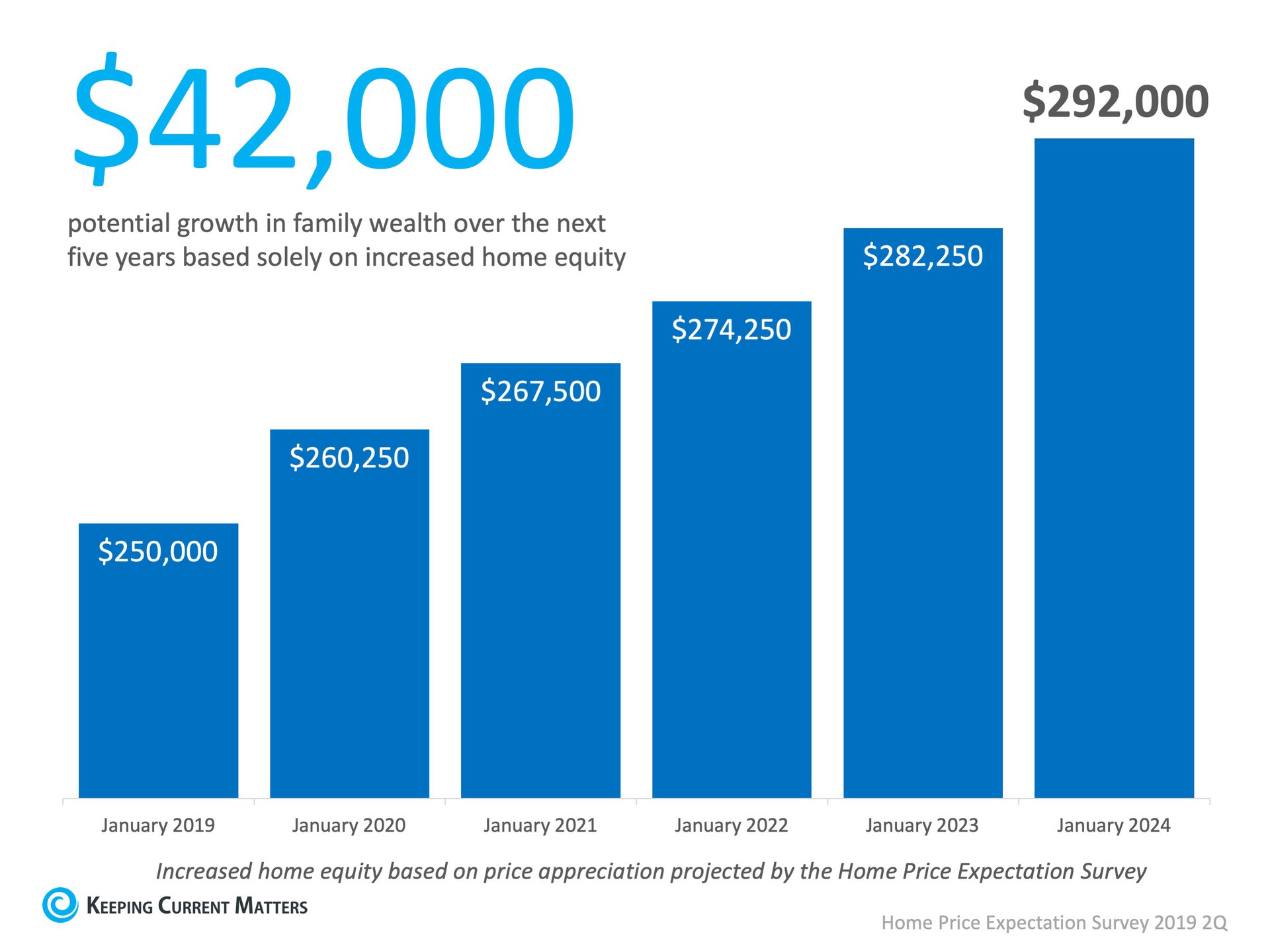
  • Home values will appreciate by 4.1% in 2019
  • The average annual appreciation will be 3.2% over the next 5 years
  • The cumulative appreciation will be 16.8% by 2023
  • Even experts representing the most “bearish” quartile of the survey project a cumulative appreciation of over 6.7% by 2023

What does this mean for you?

A substantial portion of family wealth comes from home equity. As the value of a family’s home (an asset) increases, so does their equity.

Using the projections from the HPES, here is a look at the potential equity a family could earn over the next five years if they purchased a $250,000 home in January of 2019:How to Increase Your Equity Over the Next 5 Years | Keeping Current MattersBased on gains in home equity, their family wealth could increase by $42,000 over that five-year period.

Bottom Line

If you don’t yet own a home, now may be the time to purchase. Owning or moving up to your dream home could allow you to ride the increase in equity of a growing asset.
Home Price Expectation survey – Every quarter, Pulsenomics surveys a distinguished panel of over 100 economists, investment strategists, and housing market analysts regarding their 5-year expectations for future home prices in the United States.

Tuesday, July 16, 2019

Should I Refinance My Home?


With the recent lower interest rates, many homeowners are wondering if they should refinance.
To decide if refinancing is the best option for your family, start by asking yourself these questions:

Why do you want to refinance?

There are many reasons to refinance, but here are three of the most common ones:
  1. Lower your interest rate and payment – This is the most popular reason. If you have a 5% interest rate or higher, it might be worth seeing if you can take advantage of the current lower interest rates, hovering below 4%, to reduce your monthly payment and overall cost of the loan.
  2. Shorten the term of your loan – If you have a 30-year loan, it may be advantageous to change it to a 15 or 20-year loan to pay off your mortgage sooner.
  3. Cash-out refinance – With home prices increasing, you might have enough equity to cash out and invest in something else, like your children’s education, a vacation home, or a new business.
Once you know why you might want to refinance, ask yourself the next question:

How much is it going to cost?

There are fees and closing costs involved in refinancing, and Lenders Network explains:
“If you were to refinance that loan into a new loan, total closing costs will run between 2%-4% of the loan amount.”
They also explain that there are options for no-cost refinance loans, but be on the lookout:
“A no-cost refinance loan is when the lender pays the closing costs for the borrower. However, you should be aware that the lender makes up this money from other aspects of the mortgage. Usually pay charging a slightly higher interest rate so they can make the money back.”
If you’re comfortable with the costs of refinancing, then ask yourself one more question:

Is it worth it?

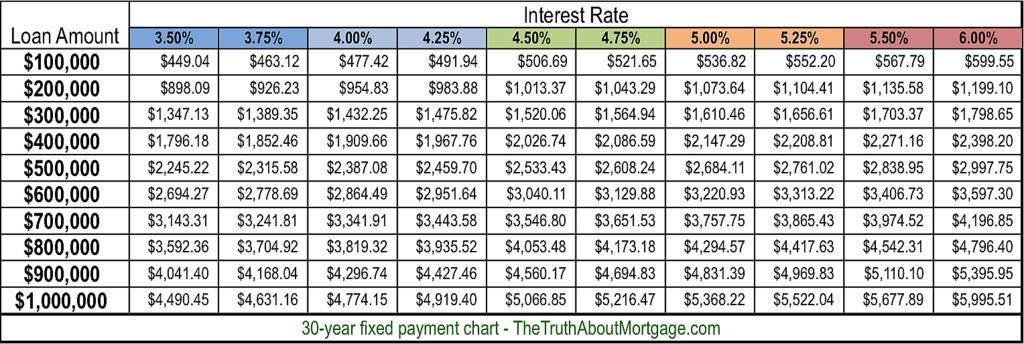
To answer this one, we’ll use an example. Let’s assume you have a $200,000 home loan. A 4% refinance cost will be $10,000. If you want to lower your interest rate from 6% to 4%,  then refinancing is going to save you $244 per month. To break even ($10,000/$244), you need to continue owning your home for over 40 months.

Now that you know how the math shakes out, think about how much longer you’d like to own your current home. If you plan to stay for more than 3 years, then maybe it is advantageous for you to refinance.

If, however, your current home does not fulfill your present needs, you might want to consider using your potential refinance costs for a down payment on a new move-up home. You will still get a lower interest rate than the one you have on your current house, and with the equity you’ve already built, you can finally purchase the home of your dreams.

Bottom Line

There are many opportunities for growth in the current real estate market. To find out what’s right for your family, meet with a local real estate professional who can help you understand your options and guide you toward the best decision.

Thursday, June 27, 2019

Know What to Expect at Your Home Inspection


So you made an offer and it was accepted. Now, your next task is to have the home inspected prior to closing. Agents oftentimes make your offer contingent on a clean home inspection.

This contingency allows you to renegotiate the price you paid for the home, ask the sellers to cover repairs, or in some cases, to walk away. Your agent can advise you on the best course of action once the report is filed.

How to Choose an Inspector

Your agent will most likely have a short list of inspectors that they have worked with in the past that they can recommend to you. HGTV recommends that you consider the following five areas when choosing the right home inspector for you:
1. Qualifications – find out what’s included in your inspection and if the age or location of your home may warrant specific certifications or specialties.
2. Sample Reports – ask for a sample inspection report so you can review how thoroughly they will be inspecting your dream home. In most cases, the more detailed the report, the better.
3. References – do your homework – ask for phone numbers and names of past clients who you can call to ask about their experiences.
4. Memberships – Not all inspectors belong to a national or state association of home inspectors, and membership in one of these groups should not be the only way to evaluate your choice. Membership in one of these organizations often means that continued training and education are provided.
5. Errors & Omission Insurance – Find out what the liability of the inspector or inspection company is once the inspection is over. The inspector is only human, after all, and it is possible that they might have missed something they should have seen.
Ask your inspector if it’s okay for you to tag along during the inspection. That way they can point out anything that should be addressed or fixed.
Don’t be surprised to see your inspector climbing on the roof or crawling around in the attic and on the floors. The job of the inspector is to protect your investment and find any issues with the home, including but not limited to: the roof, plumbing, electrical components, appliances, heating & air conditioning systems, ventilation, windows, the fireplace and chimney, the foundation, and so much more!

Bottom Line

They say, ‘ignorance is bliss,’ but not when investing your hard-earned money into a home of your own. Work with a professional who you can trust to give you the most information possible about your new home so that you can make the most educated decision about your purchase.

Wednesday, June 19, 2019

Summertime Selling Tips


Since school is out and the days are longer, summertime is the perfect time to put your house on the market. Take advantage of warmer weather to spruce up areas that need it. Make sure that when prospective buyers come to look at your home it gleams under the summer sun.

Freshen Up

It's amazing what a big difference a bit of freshening up can make. Indoor and outdoor spaces alike need to reflect the care you’ve given them. It's a good idea to patch holes in drywall, clean carpet and make any repairs that might be a safety concern. A fresh coat of paint can make a dramatic difference. Repaint any rooms that could use some brightening. You don't need to paint the exterior of your house to freshen it up. Try pressure washing siding and decking so that everything looks pristine.

Decorate More Generically

As precious as your family photos are, they are not ideal for potential homebuyers and can be distracting. Clear out any personal items in your home like photos, collections and award certificates. This also includes items that might be considered controversial, such as political flags or morally questionable paraphernalia. It’s not always easy, but it will help you sell more quickly in the long run.

Keep the Outdoors Great

Even if the sun can turn your skin to bronze, you don’t want the same effect on your lawn and garden. Water regularly to keep your grass lush and to make wilted flowers stand up tall and proud once more. Also, don’t underestimate the power of curb appeal; trimmed grass and hedges make a bigger difference than you might think.

Stage the Home

Once the house is clean and working like a well-oiled machine, make it even more beautiful with staging. Professionally staging the home means that furniture and decor are brought into the home by a decorator. This process makes for a clean and cohesive look. Staging can make a huge impact on people who are touring the house.
Use the brightest season of the year to highlight your home’s beauty. You already know it’s a gem, so show buyers why they should think so too!

Tuesday, June 18, 2019

Empty Nest? 5 Changes Your Home Needs Now That It’s Kid-Free


The house you raised your family in has seen a lot — a lot of love and laughter and maybe a little turmoil. Now that your home is officially kid-free, it is in dire need of some enhancements so you can make a smooth transition from being a full-time parent to having a less hands-on relationship with your children.
Check out these five changes your home is begging for now that you have an empty nest.
First-Floor Guest Bedroom
Think about rearranging the layout of your home now that the kids are out of the house. You might already have plans to turn one of your kids’ bedrooms into a guest bedroom; however, if it’s on the second floor, consider using a room on the first floor. For now, you can use it for guests, but if you plan to stay in your home for the rest of your life, you may want your bedroom to be on the first floor when you get older.
Create Extra Space With Fewer Walls
If you have a few smaller rooms that were once kids’ bedrooms, consider knocking down a wall or two to create one larger space. It makes sense to have lots of smaller rooms if you have a house full of kids, but now that it’s just you or you and your spouse, you can keep one bedroom for guests and create a bigger room to serve a more meaningful purpose, such as a studio, office or home gym.
Kitchen Facelift 
With lots of people in the house, it can be tricky to do any kind of home upgrade or renovation. Now that you have an empty nest, consider making kitchen upgrades that you’ve been putting off. Does the tile need work? Do the cabinets need replacing or maybe just some paint? You could also update old appliances — now is the best time to do whatever needs to be done to bring your kitchen up to date.
Master Bath Enhancements 
With kids out of the house, you will have more time to yourself and hopefully to pamper yourself. Make some updates to the master bathroom by changing the counters and cabinets and/or adding ambient lighting with a dimmer. Add a bench in the shower and a heated towel rack. Replace towels with ones that are plush and soft. Do whatever is necessary to make your bathroom feel more like a spa. You deserve it!
Update Your Most-Used Furniture
Maybe you didn’t want to invest in high-end furniture while you were raising kids because you feared stains and smears on expensive items. However, now is the time to invest in a little luxury. You can transform your home into more of an adults’ house by swapping out some older pieces of furniture for something tasteful and refined.
Looking for even more ways to update your home? Give us a call today! We love sharing our expertise.

Wednesday, June 12, 2019

3 Things to Know in the Housing Market Today!


A lot is happening in the world, and it’s having a direct impact on the housing market. The reality is this: some of it is positive and some of it may be negative. Some we just don’t know yet.


The following three areas of the housing market are critical to understand: interest rates, building materials, and the outlook for an economic slowdown.

1. Interest Rates

One of the most important things to consider when buying a home is the interest rate you will be charged to borrow the money. In our recent post we posed the question, “Are Low Interest Rates Here To Stay?” The latest information from Freddie Mac makes it appear they are. We are currently at a 21-month low in interest rates.3 Things to Know in the Housing Market Today! | Keeping Current Matters

2. Building Materials

Talk of tariffs could also affect the housing market. According to a recent article, the National Association of Home Builders reports that as much as $10 billion in goods imported from China are used in homebuilding. Depending on the outcome of the tariff and trade discussions between several countries, there could be as much as a 25% boost in the cost of building materials.

3. Economic Slowdown

In a prior blog post on this topic, we began the year with many economic leaders thinking we could expect a recession in late 2019 or early 2020. As spring approached, we reported that economists had started to push that projection past 2020.  Now, three leading surveys indicate that it may begin in the next eighteen months.3 Things to Know in the Housing Market Today! | Keeping Current Matters

Bottom Line

We are in a strong housing market. Wages are increasing, home prices are appreciating, and mortgage rates are the lowest they have been in 21 months.  Whether you are thinking of buying or selling, it’s a great time to be in the market.

Tuesday, April 11, 2017

Renting Vs. Buying


There are many benefits to homeownership. One of the top benefits is being able to protect yourself from rising rents by locking in your housing cost for the life of your mortgage.

Thursday, April 6, 2017

Market Condition

In real estate, the terms buyer’s market and seller’s market are tossed around quite often. First-time home buyers or those with experience buying in a buyer’s market may be caught off guard when trying to navigate the current market trends. When inventory is low and demand is high the “power” swings from the buyer to the seller.

Monday, April 3, 2017

Mistakes Home Buyers Make


Buying a home is not a DIY process. Avoid the pitfalls that unfortunately happen all too often. Call, text, or email me if you have questions about buying a home in Atlanta or real estate in general. timgrissett.com

Thursday, March 30, 2017

Dream Home


What do you all think of this stately study, featuring wood panel walls and bamboo hardwoods?


Burn calories and work off stress in this user-friendly home gym that offers top-notch equipment and exercise accessories in a stylish setting with a great view of the backyard. What do you think?


As we know, the beautiful house is not about its price. The house architecture is the most important thing for its beautiful impression. You can get your own dream house by defining the house architecture theme. The serene layout with its chic appearance is also a good element that actually will bring nice accent. Beautiful is not always expensive. By using chic and compact layout on house design, you can still have mesmerizing home style with fabulous appearance. Are you ready to dream again?

Monday, March 27, 2017

Selling A Home "As-Is"


Fixer-uppers can be a challenge  to market. Many prospective home buyers are looking for a move-in ready home that will be reliable. Some people are turned off by the idea of having to invest time and money in renovations, and the fear of the unknown is enough to have them overlook any properties that are being sold as-is. Despite the number of homeowners who disregard any fixer-uppers, there is a lot of potential in selling a home as-is. If you’re looking to sell your home quickly, then listing it as-is could be the right option for you. With the right marketing knowledge, you can find qualified buyers, market a fixer-upper at the right price and get it sold quickly and for more money. Contact me today if you have questions about listing your home "As-Is".