Showing posts with label FHA. Show all posts

Thursday, January 2, 2020

The 2020 Real Estate Projections That May Surprise You


This will be an interesting year for residential real estate. With a presidential election taking place this fall and talk of a possible recession occurring before the end of the year, predicting what will happen in the 2020 U.S. housing market can be challenging. As a result, taking a look at the combined projections from the most trusted entities in the industry when it comes to mortgage rates, home sales, and home prices is incredibly valuable – and they may surprise you.

Mortgage Rates

Projections from the experts at the National Association of Realtors (NAR), the Mortgage Bankers Association (MBA), Fannie Mae, and Freddie Mac all forecast mortgage rates remaining stable throughout 2020:The 2020 Real Estate Projections That May Surprise You | Keeping Current MattersSince rates have remained under 5% for the last decade, we may not fully realize the opportunity we have right now.
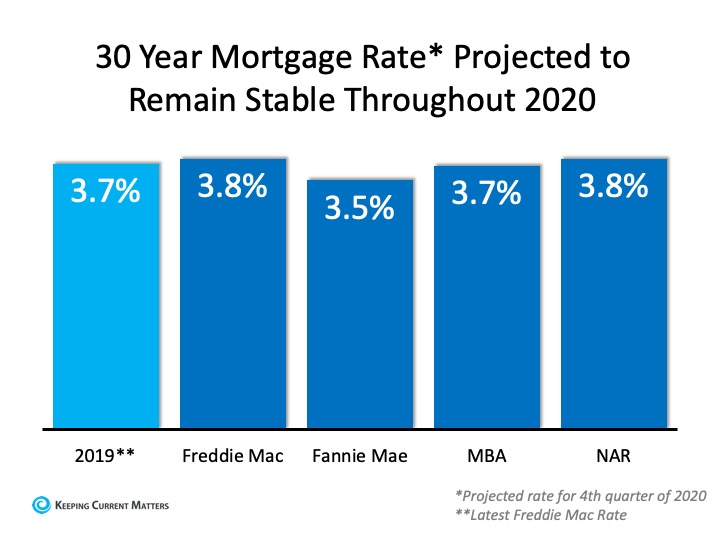
Here are the average mortgage interest rates over the last several decades:
  • 1970s: 8.86%
  • 1980s: 12.70%
  • 1990s: 8.12%
  • 2000s: 6.29%

Home Sales

Three of the four expert groups noted above also predict an increase in home sales in 2020, and the fourth sees the transaction number remaining stable:The 2020 Real Estate Projections That May Surprise You | Keeping Current MattersWith mortgage rates remaining near all-time lows, demand should not be a challenge. The lack of available inventory, however, may moderate the increase in sales.

Home Prices

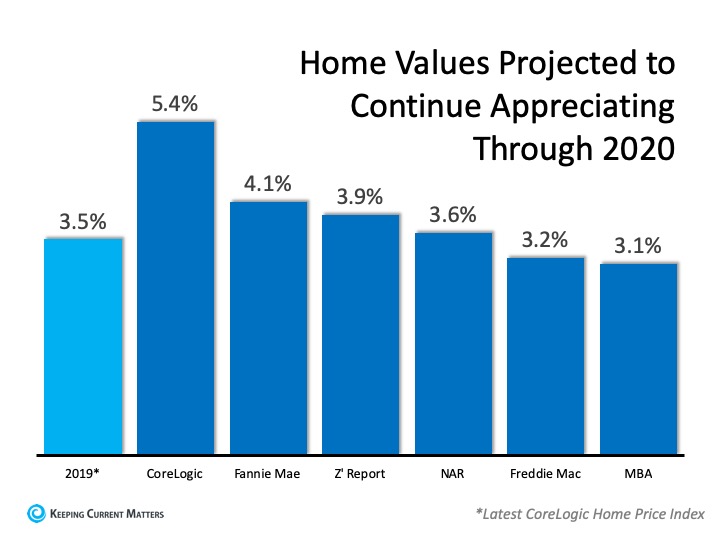
Below are the projections from six different expert entities that look closely at home values: CoreLogic, Fannie Mae, Ivy Zelman’s “Z Report”, the National Association of Realtors (NAR), Freddie Mac, and the Mortgage Bankers Association (MBA).The 2020 Real Estate Projections That May Surprise You | Keeping Current MattersEach group has home values continuing to improve through 2020, with four of them seeing price appreciation increasing at a greater pace than it did in 2019.
Is a Recession Possible?

In early 2019, a large percentage of economists began predicting a recession may occur in 2020. In addition, a recent survey of potential home purchasers showed that over 50% agreed it would occur this year. The economy, however, remained strong in the fourth quarter, and that has caused many to rethink the possibility.
For example, Goldman Sachs, in their 2020 U.S. Outlook, explained:
“Markets sounded the recession alarm this year, and the average forecaster now sees a 33% chance of recession over the next year. In contrast, our new recession model suggests just a 20% probability. Despite the record age of the expansion, the usual late-cycle problems—inflationary overheating and financial imbalances—do not look threatening.”

Bottom Line

Mortgage rates are projected to remain under 4%, causing sales to increase in 2020. With growing demand and a limited supply of inventory, prices will continue to appreciate, while the threat of an impending recession seems to be softening. It looks like 2020 may be a solid year for the real estate market.

Friday, December 13, 2019

VA Loan Limits Removed


Veterans are no longer restricted to a loan limit beginning January 1, 2020.  Previously, veterans were limited by the same restrictions set by the Federal Housing Finance Agency on conforming loans.  While these limits were national in nature, there were exceptions for high-cost counties and jumbo loan procedures.

The elimination of loan limits doesn't mean that veterans will have unlimited borrowing power.  Buyers must still qualify with enough income and credit requirements to meet the lender's requirements to qualify for the loan.

Lenders can set their own in-house maximum loan amounts which means it could vary from lender to lender.  Veterans who have an active VA loan or have defaulted on a previous VA loan are still limited by the previous loan limits.

The VA funding fee is increasing on January 1, 2020 to 2.3% of the loan amount for "first-use" borrowers from the previous fee of 2.15%.  Subsequent use borrowers will pay 3.6% of the loan amount instead of the current 3.3%.

Beginning in 2020, the funding fees will be the same for regular military, National Guard and reservists.  At the same time, Purple Heart recipients are exempt from paying the VA funding fee.
It is recommended that a veteran, as well as any buyer, be pre-approved before beginning the home buying process.  Veterans can find answers to specific questions they may have from a qualified and trusted loan professional.

Thursday, May 23, 2019

2019 Colors of the Year


It’s that fun time of the year where us paint color geeks look forward to the paint manufacturers announcing their annual “Colors of the Year”.  Most of the manufacturers have announced their colors in the last couple of weeks and today I’m excited to share the 2019 Colors of the Year with you from Sherwin Williams, BEHR, Ace’s Clark + Kensington, PPG and Dutch Boy.

Friday, August 17, 2018

The Cost of Waiting: Interest Rates Edition


Interest rates are projected to increase steadily heading into 2019. The higher your interest rate, the more money you end up paying for your home and the higher your monthly payment will be. Rates are still low right now – don’t wait until they hit 5% to start searching for your dream home!

Thursday, April 13, 2017

Home Mortgages: Rates Up, Requirements Easing


The media has extensively covered the rise in mortgage interest rates since last fall (from 3.42% last September to the current 4.1% according to Freddie Mac). However, a less covered aspect of the mortgage market is that requirements to get a mortgage have eased while rates have risen. The Mortgage Bankers Association (MBA) quantifies the availability of mortgage credit each month with their Mortgage Credit Availability Index (MCAI). According to the MBA, the MCAI is:
“A summary measure which indicates the availability of mortgage credit at a point in time.”
The higher the index, the easier it is to get a mortgage. Here is a chart showing the MCAI over the last several months as rates have increased. Home Mortgages: Rates Up, Requirements Easing | Keeping Current Matters

Have requirements for attaining a mortgage actually eased?

Yes. Here are two examples:
  1. FICO® Score – the credit score which helps determine a buyer’s eligibility. The score required to attain a mortgage has been falling over the last five months:
Home Mortgages: Rates Up, Requirements Easing | Keeping Current Matters
  1. Down Payment Requirement – the percentage of the purchase price necessary to place as a down payment on a home. To make this point, let’s look at the percentage of first-time buyers who have put less than 5% down over the last several years as compared to the 1st quarter of 2017:
Home Mortgages: Rates Up, Requirements Easing | Keeping Current Matters

Bottom Line

Whether you are a current homeowner looking to move to a home that will better serve your family’s current needs, or a first-time buyer looking for a starter home, it is easier to get a mortgage today than it has been at any other time in the last ten years.

Wednesday, February 22, 2017

Friday, November 25, 2016

What You Need to Know About the Mortgage Process [INFOGRAPHIC]


Some Highlights:

  • According to Freddie Mac, 40% of buyers are putting less than 10% down, with many putting down as little as 3%.
  • Have a budget and stick to it!
  • Know your credit score and history!
  • Reach out to a professional who can help you with the process!

Tuesday, November 22, 2016

Why Are Mortgage Interest Rates Increasing?

According to Freddie Mac's latest Primary Mortgage Market Survey, the 30-year fixed rate mortgage interest rate jumped up to 3.94% last week. Interest rates had been hovering around 3.5% since June, and many are wondering why there has been such a significant increase so quickly. Why did rates go up?

Whenever there is a presidential election, there is uncertainty in the markets as to who will win. One way that this is noticeable is through the actions of investors. As many investors pull their funds from the more volatile and less predictive stock market and instead, choose to invest in Treasury Bonds. When this happens, the interest rate on Treasury Bonds does not have to be as high to entice investors to buy them, so interest rates go down. Once the elections are over and a President has been elected, investors return to the stock market and other investments, leaving the Treasury to raise rates to make bonds more attractive again. Simply put, the better the economy, the higher interest rates will go. For a more detailed explanation of the many factors that contribute to whether interest rates go up or down, you can follow this link to Investopedia.The Good News

Even though rates are closer to 4% than they have been in nearly 6 months, they are still slightly below where we started 2016, at 3.97%. The great news is that even at 4%, rates are still significantly lower than they have been over the last 4 decades, as you can see in the chart below.


Any increase in interest rate will impact your monthly housing costs when you secure a mortgage to buy your home. A recent Wall Street Journal article points out that,"While still only roughly half the average over the past 45 years, according to Freddie Mac, the quick rise has lenders worried that home loans could become more expensive far sooner than anticipated." Tom Simons, a Senior Economist at Jefferies LLC, touched on another possible outcome for higher rates:"First-time buyers look at the monthly total, at what they can afford, so if the mortgage is eaten up by a higher interest expense then there's less left over for price, for the principal. Buyers will be shopping in a lower price bracket; thus demand could shift a bit."

Bottom Line

Interest rates are impacted by many factors, and even though they have increased recently, rates would have to reach 9.1% for renting to be cheaper than buying. Rates haven't been that high since January of 1995, according to Freddie Mac.

Tuesday, November 15, 2016

A Lack of Listings Remains 'Huge' Challenge in the Market


The housing crisis is finally in the rearview mirror as the real estate market moves down the road to a complete recovery. Home values are up, home sales are up, and distressed sales (foreclosures & short sales) are at their lowest mark in over 8 years. This has been, and will continue to be, a great year for real estate. However, there is one thing that may cause the industry to tap the brakes: a lack of housing inventory. According to the National Association of Realtors (NAR), buyer traffic and demand continues to be the strongest it has been in years. The supply of homes for sale has not kept up with this demand and has driven prices up in many areas as buyers compete for their dream home. Traditionally, the winter months create a natural slowdown in the market. Jonathan Smoke, Chief Economist at realtor.com, points to low interest rates as one of the many reasons why buyers are still out in force looking for a home of their own.
"Overall, the fundamental trends we have been seeing all year remain solidly in place as we enter the traditionally slower sales season, and pent-up demand remains substantial as buyers seek to get a home under contract while rates remain so low."
NAR's Chief Economist, Lawrence Yun, points out that the inventory shortage we are currently experiencing isn't a new challenge by any means:
"Inventory has been extremely tight all year and is unlikely to improve now that the seasonal decline in listings is about to kick in. Unfortunately, there won't be much relief from new home construction, which continues to be grossly inadequate in relation to demand."

Bottom Line

Healthy labor markets and job growth have created more and more buyers who are not just ready and willing to buy but are also able to. If you are debating whether or not to put your home on the market this year, now is the time to take advantage of the demand in the market.

Friday, November 11, 2016

The Truth About Housing Affordability


From a purely economic perspective, this is one of the best times in American history to buy a home. Black Night Financial Services discusses this in their most recent Monthly Mortgage Monitor. Here are two of the report's revelations:
  1. The average U.S. home value increased by $13,500 from last year, but low interest rates have kept the monthly principal & interest payment needed to purchase a median-priced home almost equal to one year ago.
  2. Home affordability still remains favorable compared to long-term historic norms.
The report explains:
"Even though the value of the average home in the U.S. increased by about $13,500 over the last year, thanks to declining interest rates it actually costs almost exactly the same in principal and interest each month to purchase as it did this time last year. Even taking into account the fact that affordability can vary - sometimes significantly - across the country based upon the different rates of home price appreciation we're seeing, that's a pretty incredible balancing act between interest rates and home prices at the national level... Right now, it takes 20 percent of the median monthly income to cover monthly payments on the median-priced home, which is well below historical norms." However, the report warns that affordability will be dramatically impacted by an increase in mortgage rates. "A half-point increase in interest rates would be equivalent to a $17,000 jump in the average home price, and bring that ratio to 21.5 percent. This increase is still below historical norms, but puts more pressure on homebuyers."

Bottom Line

If you are ready and willing to purchase a home of your own, find out if you're able to. Now is a great time to jump in.

Tuesday, November 8, 2016


Always use a professional...for one of the biggest expenses in life, never try to go it alone, or worse, use an amateur. If you’re thinking about buying a home in 2017, you need to take action now.

Tuesday, November 1, 2016

FHA 101


FHA is the largest insurer of residential mortgages in the world. FHA loan requirements and guidelines cover things like mortgage insurance, lending limits, debt to income ratios, credit issues, and closing costs. In order to prevent homebuyers from getting into a home they cannot afford, FHA guidelines have been set in place.